
MW800 Mobile Workstation
Technical articles, guides and resources for communication hobbyists...
The Motorola MW800 Mobile Workstation was designed as a rugged, high-performance solution for mobile professionals in law enforcement, emergency services, and field operations. Building on a modular, vehicle-mounted architecture, the MW800 Mobile Workstation provided reliable computing power, advanced wireless connectivity, and an intuitive user interface for mission-critical applications. Its durable chassis and sunlight-readable touchscreen enabled seamless operation in challenging mobile environments, while flexible input/output options supported integration with vehicle systems and peripherals. By delivering real-time data access, GPS navigation, and secure communication on the move, the MW800 Mobile Workstation established itself as a trusted platform for agencies requiring dependable, in-vehicle computing.

A Brief History of the MW800 Mobile Workstation
The Motorola MW800 Mobile Workstation was introduced in the early 2000’s as the next-generation successor to the MW520 Mobile Workstation. Designed as a rugged, high-performance mobile computing platform, the MW800 Mobile Workstation targeted public safety, emergency services, utilities, and other mission-critical field operations. At launch, the estimated MSRP for a base MW800 configuration typically fell in the $2,000–$3,000+ range, positioning it as a more capable, but still cost-effective solution compared to its future successor, the MW810 Mobile Workstation.
As mobile data usage rapidly increased, agencies required in-vehicle computing systems that could operate reliably in harsh environments while delivering improved processing power, connectivity, and expandability. The MW800 Mobile Workstation addressed these needs through a modular, split-architecture design, consisting of a vehicle-mounted central processing unit (CPU) paired with a separate touchscreen display. This approach reduced heat buildup in the cabin, improved system reliability, and allowed greater flexibility when installing equipment in increasingly crowded vehicle interiors.
The MW800 Mobile Workstation ran Microsoft Windows operating systems, including Windows XP, enabling compatibility with a wide range of law enforcement, emergency response, and dispatch applications common at the time. It utilized Intel-based processors, typically Pentium III or Mobile Pentium M chipsets, along with upgradable system memory and ruggedized storage options designed for mobile use. Integrated support for GPS, Wi-Fi, Bluetooth, and cellular modems provided real-time access to databases, mapping, and communications from virtually any location.
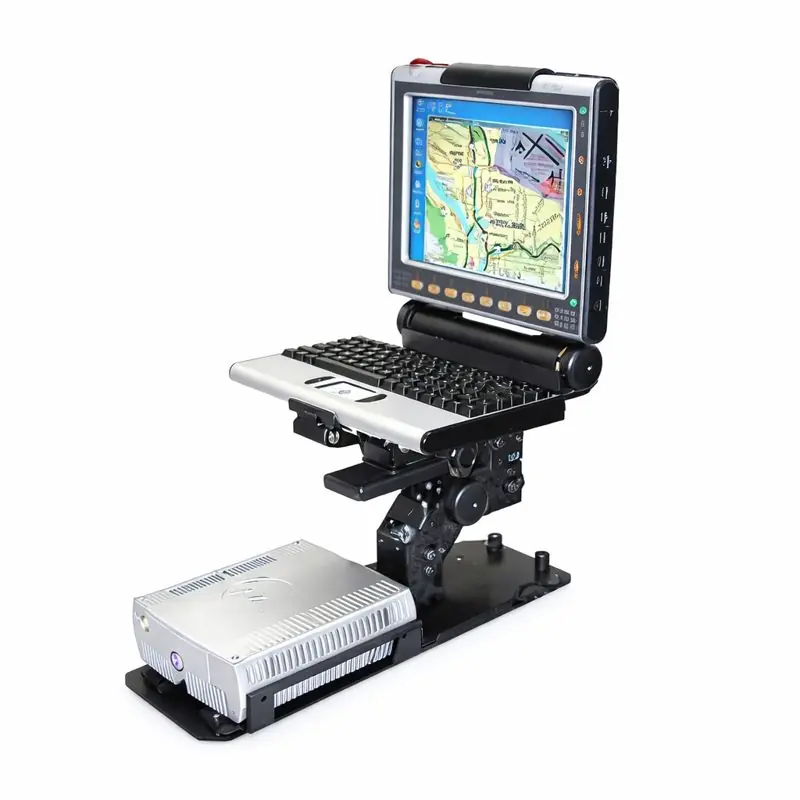
Built to withstand demanding field conditions, the MW800 Mobile Workstation featured a hardened chassis designed to meet MIL-STD-810 specifications, offering resistance to shock, vibration, dust, moisture, and extreme temperatures. These durability characteristics made it well suited for installation in patrol cars, fire apparatus, ambulances, utility vehicles, and other mobile platforms. As a result, the MW800 Mobile Workstation saw widespread adoption by police departments, emergency response agencies, and utility providers across North America and beyond.
Throughout its lifecycle, the MW800 Mobile Workstation was refined through firmware updates and supported a broad ecosystem of optional accessories. These included vehicle docks, backlit keyboards, touch displays, and expanded I/O capabilities for peripherals such as mobile printers, cameras, license plate readers, and specialized radio or data interfaces. However, as operational demands grew for faster processors, higher-resolution displays, and more advanced wireless technologies, the MW800 eventually reached the limits of its hardware platform. It was ultimately phased out in favor of the MW810 Mobile Workstation, which built upon the MW800’s proven design while introducing more modern computing performance, enhanced connectivity, and expanded capabilities for an increasingly data-driven mobile workforce.
Marketing Materials
Type: PDF | Version: R.00.00.00 | Size: 0 KB
Type: PDF | Version: R.00.00.00 | Size: 0 KB
Instillation Guides & Manuals
Type: PDF | Version: R.00.00.00 | Size: 0 KB
Type: PDF | Version: R.00.00.00 | Size: 0 KB
User Guides & Manuals
Type: PDF | Version: R.00.00.00 | Size: 0 KB
Type: PDF | Version: R.00.00.00 | Size: 0 KB
Service Bulletins, Guides & Manuals
Type: PDF | Version: R.00.00.00 | Size: 0 KB
Type: PDF | Version: R.00.00.00 | Size: 0 KB
Software & Driver Packages
Type: PDF | Version: R.00.00.00 | Size: 0 KB
Type: PDF | Version: R.00.00.00 | Size: 0 KB

