WA8IQO's Origin
The amateur radio call sign WA8IQO traces its origins to the United States Federal Communications Commission (FCC) call sign assignment system. The assignment system designates unique identifiers to licensed amateur radio operators. The prefix “WA” indicates that the license was first issued in 1969. During this era when “W” and “K” prefixes were commonly used. The numeral “8” represents the FCC’s 8th call district, which historically included Ohio and Michigan. The suffix “IQO” is a sequentially assigned three-letter combination, completing the call sign’s distinct identity.
The First License Holder
WA8IQO was originally assigned to my father. He began his communications journey while serving in the United States Navy during the Vietnam War. Much of what he did remains somewhat unknown to me. I do know that at some point in his tour he was stationed in Nome, Alaska were he played a critical role. He spent his days intercepting and deciphering encrypted Russian radio communications.
Following the completion of his naval service, he returned to civilian life. He received his General Operator Class designation, and was issued the call sign WA8IQO by the FCC. During the 1970s, he was an active member of the local amateur radio community. He played a significant role in civil defense efforts, particularly through the Radio Amateur Civil Emergency Service (RACES). RACES was established to provide emergency communications during national crises or natural disasters. He contunued to activley partiapate in amature radio untill his passing in the early eighties.
I have fond memories of rushing to follow him out of the house during severe weather events. Volunteering as a Skywarn storm spotter, he would call net control to give reports. Those experiences may have laid the groundwork for my twenty-year career in public safety. More importantly it lead me to become the second WA8IQO licensee.
The Second License Holder
I have only been licensed as an amateur radio operator under the call sign WA8IQO since 2007. It took me over twenty years after my father’s passing to carry on the legacy. If memory serves me correctly, the FCC introduced a new rule in the early 2000’s. This rule allowed immediate family members of a silent key to apply for and inherit a family member’s call sign. As with most government requirements, there were stipulations and plenty of red tape. I began the long, drawn-out process and started jumping through all the hoops. The process dragged on, life got in the way, and before I knew it, I had lost interest.
A few years later, I found out that a local amateur radio club was offering free exam preparation classes. These classes coincided with the FCC’s recent removal of the Morse code requirement, and the classes were meant to boost the club’s membership. I signed up and attended twice a week. During the class, I learned that the FCC had also recently introduced “vanity” call signs, and that it was now simpler to carry on the WA8IQO designation.
WA8IQO - Amateur Radio Hobbyist & Motorola Enthusiast
What makes me different from my father is I’m also a Motorola enthusiast. Amateur radio hobbyist also referred to as a “Ham Radio Operator” who use Motorola commercial radios are a small minority. Hobbyists like myself who use a Motorola commercial radios bring a unique perspective to the hobby of Amateur Radio communications.
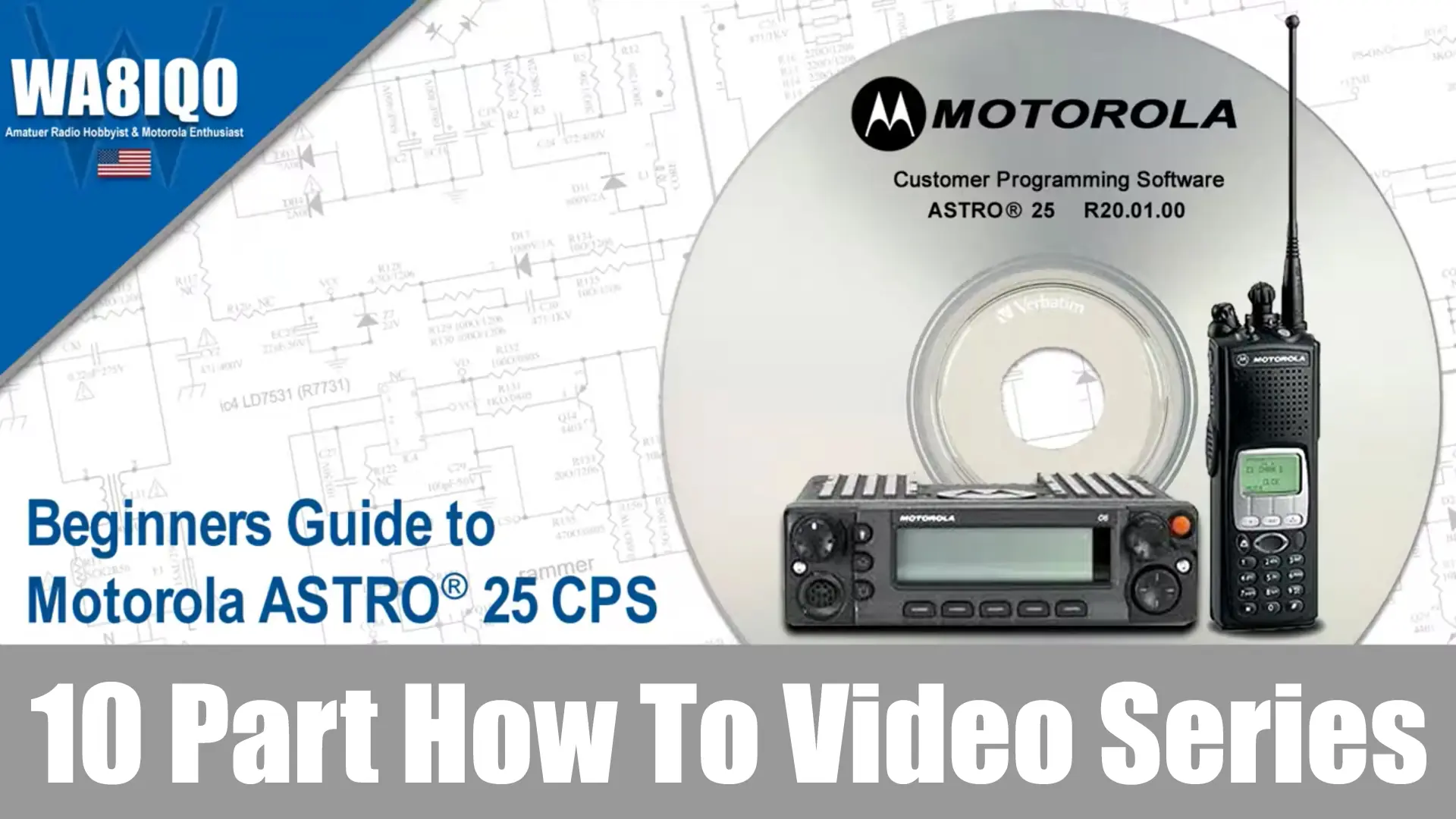
Exploring two diverse worlds, the challenges I encountered between amateur radio and commercial radio were frustrating to say the least. I faced many challenges and a steep learning curve. Motorola commercial radios are more readily available today then every. Used and surplus Motorola XTS 5000 and Motorola XTL 5000 are two of my favorite ASTRO 25 radios. There easyley found on eBay by the hundreds from private and government sectors for a few hundred dollars. The problems I’ve encountered have been the availability of resources and meeting peers who are knowledgeable. Especially ones willing to share the information.
The Future WA8IQO Call Sign
The call sign WA8IQO is not just letters and numbers, it a living legacy. It began with my father’s service to both his country and community. It continues today as a symbol of dedication, communication, and connection. to him.
My hope is that WA8IQO will remain in the family for generations to come. Just as I followed my father’s footsteps, I would like to see one of my children take an interest. They too could discover the joy and purpose it brings, and eventually carry on the WA8IQO call sign after me.
Amateur radio is more than a pastime, it’s a bridge between people, places, and generations. When my time comes and I become “silent”, I hope that the voice of WA8IQO will continue. To be heard on the airwaves, keeping alive not only a call sign but also the spirit of community service, curiosity, and connection that it has always represented.
Final Thoughts
The story of WA8IQO is more than the history of a call sign, it is the story of service, passion, and family legacy. From my father’s role in the U.S. Navy, where he used his skills to safeguard our nation, to his dedication as a civilian operator supporting civil defense and Skywarn, the call sign has always symbolized commitment to communication and community. Today, as I continue in his footsteps, my hope is that this tradition will remain within the family, inspiring future generations to discover the value of amateur radio and carry forward the proud legacy of WA8IQO.