
Home |
Prototype and modeling articles fueling passion for all things trains...
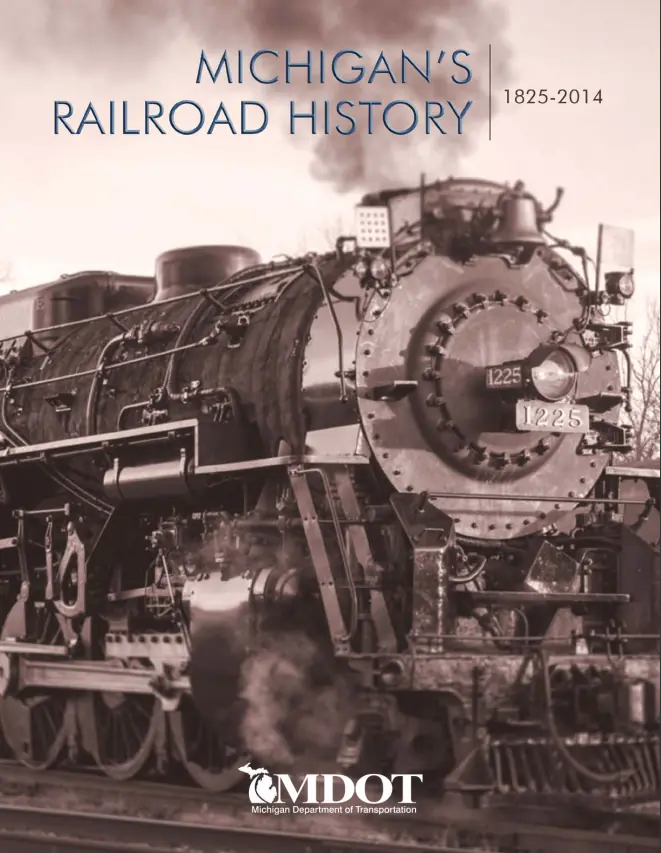
This Timeline to Michigan Railroad History is full of events that have played a major role in the development of the state. It has also cultivated my interests in Railfanning while driving my Latest Trains & Model Railroad Content. The timeline I’m presenting here was originally published by the Michigan Department of Transportation (MDOT) in 1987. A number of organizations and individuals contributed to the document’s development as part of Michigan’s 150th birthday celebration.
Much of the Timeline to Michigan Railroad History I’m presenting here is from a revised version (date unknown) of the original 1987 document. It has been modified to conform to modern web design best practices. When available, I will attempt to fill in the blanks and update the information beyond 2014. The document is available for download below.
Type: PDF | Version: Unknown | Size: 3 MB
Michigan’s railroad system expanded significantly after its beginnings in the 1830. It peaked at over 9,000 route miles by the early 1900s. As roads improved and the use of automobiles and trucks increased, the amount of track declined. By 2014, Michigan had approximately 3,600 miles of railroad. In April 2025, the Association of American Railroads (AAR) estimated this number had fallen to 3,344 miles. This included 665 miles of state-owned lines.
Intercity passenger rail service began in 1846. Privately owned railroads provided this service until 1971. That year, Amtrak was created to operate the nation’s intercity passenger rail system. From 1971 to 2014, Amtrak’s service in Michigan has evolved. Offering two daily round trips between Chicago and Detroit. This increased to three in 1974. The Chicago-Pontiac service (Wolverine), the Chicago-Port Huron (Blue Water) line and the Chicago-Grand Rapids (Pere Marquette) line both began in 1974 and 1984, respectively, each with one daily round trip. In 1994, the two round trips to Detroit were extended to Pontiac. The Toledo trip was also rerouted to Pontiac in 1995.
Passenger ridership was steady for many years before a significant increase after the turn of the century. In Fiscal Year (FY) 2014, statewide ridership was 769,348. According to Amtrak’s data for FY-2024, an average of 10 trains ran per day on three permanent routes, with a total of 766,073 passengers boarding or alighting in the state. Despite the decline in the number of miles of track, Michigan’s railroads continue to play an important role in the state’s economic development.
July 31, 1830: The Pontiac & Detroit Railway Co. was chartered. This charter, issued by the territorial Legislature, was the first railway charter in the state. By the time Michigan gained statehood in 1837, 23 private railroad companies had been chartered, most of which never laid any rail.
February 1, 1832: A Michigan newspaper, The Western Immigrant of Ann Arbor, proposed the idea of a transcontinental railroad, the first printed suggestion made anywhere of such a project.
June 28, 1832: The Detroit & St. Joseph Railroad, the first railroad planned to cross Michigan, was chartered. Its name was later changed to Michigan Central Railroad (MCRR).
1833: The first railroad tracks in Michigan were laid by the Erie & Kalamazoo Railroad between Adrian and Toledo.
1836: The Michigan Central Railroad began construction west from Detroit, reaching Ypsilanti by February 1838, Ann Arbor in October 1839, and Jackson on Dec. 29, 1841.
March 28, 1836: The state chartered seven railroads in a single day.
Nov. 2, 1836: The first operating railroad west of the Alleghenies and in Michigan, the Erie & Kalamazoo Railroad, began horse-powered service between Port Lawrence (now Toledo), Ohio, and Adrian.
March 20, 1837: The Public Improvements Act of 1837 was passed, which allowed the State of Michigan to borrow up to $5 million at 5.25 percent interest to finance the construction of three railroads, two canals and other transportation projects.
July 4, 1837: First steam locomotive placed in service in Michigan, Adrian, began operating on the Erie & Kalamazoo Railroad.
1840: Railroad mileage in Michigan totaled 104 miles.
July 4,1843: The Detroit & Pontiac Railroad began service between Detroit and Pontiac.
November 25, 1845: Train operations began between Detroit and Battle Creek.
1846: Public Acts passed, authorizing sale by the State of the Michigan Southern ($500,000) and the Michigan Central ($2 million) railroad companies.
February 2,1846: Regularly scheduled passenger rail service between Kalamazoo and Detroit commenced.
April 23,1849: Michigan Central completed to New Buffalo, the first railroad to cross the state.
1850: Railroad mileage in Michigan totaled 380 miles.
Sept. 25, 1851: In the landmark Great Railroad Conspiracy case, a Detroit jury convicted 12 men for burning MCRR’s Detroit depot. The men were aggrieved at refusal of MCRR to pay for cattle killed by trains near Jackson.
1852: Last strap rails eliminated on state railroads.
1852: Michigan Southern and Michigan Central railroads completed.
Feb. 20, 1852: The Michigan Southern Railroad reached Chicago from Toledo via Adrian, Hillsdale, Coldwater and White Pigeon. This line, later called “The Old Road,” was for a few years part of the only rail line between the East Coast and Chicago.
May 21, 1852: First train operated by Michigan Central Railroad from Detroit to Chicago.
1855: Michigan Central Railroad began using the telegraph to control train operations, making it the nation’s first railroad to make widespread use of this system.
Feb. 12, 1855: State law passed requiring crews on passenger trains and depot personnel to wear a badge on a hat or cap indicating their job title or office.
Feb. 22, 1855: First common carrier railroad in the Upper Peninsula, the Iron Mountain Railroad, was chartered; its Negaunee-Marquette line was completed by August 1857. (An earlier road, the “Iron Mountain Railway,” was a privately owned horse-powered tramway.)
August 1855: The first steam locomotive in the Upper Peninsula, Sebastopol, arrived via boat at Marquette for the Iron Mountain Railroad.
1856: Michigan received its first federal railroad land grant. Under the Act of 1856, Michigan’s railroads were eventually awarded a total of 3,809,826 acres of public land.
July 1856: Detroit, Monroe & Toledo Railroad completed a Detroit-Toledo line. Later, it was leased to the Michigan Southern & Northern Indiana Railroad.
1857: First steam locomotive on a logging railroad in the nation when Blendon Lumber Co. began hauling logs on wooden rails in the Bass River Valley.
Jan. 22, 1857: Flint & Pere Marquette Railroad chartered to construct a rail line from Flint to Lake Michigan via Saginaw.
July 4, 1858: First regularly scheduled passenger train into Grand Rapids.
November 1858: Detroit & Milwaukee Railroad completed the Detroit-Grand Haven line via Owosso, Ionia and Grand Rapids.
Nov. 21, 1859: First Detroit-Fort Gratiot (Port Huron) service on the Chicago, Detroit & Canada Grand Trunk Junction Railway. At age 12, Thomas A. Edison worked on this line as a “candy butcher.”
1860: Railroad mileage in Michigan totaled 770 miles.
Jan. 5, 1861: The Amboy, Lansing and Traverse Bay Railroad Co. was the first land-grant road in Michigan to receive a certificate stating that it had completed 20 miles of acceptable track.
May 13, 1861: Company G, 3rd Regiment, Michigan Infantry moved by lumber wagons from Lansing to Bath to board the Amboy, Lansing and Traverse Bay Railroad, the nearest railroad to Lansing. It was the state’s first known movement of troops by railroad.
Dec. 8, 1862: Flint & Pere Marquette began scheduled train service to Flint.
April 1863: In a meeting held in Marshall, 13 Michigan Central Railroad men planned a national railwaymen’s organization, resulting the following month in the founding in Detroit of the Brotherhood of Locomotive Engineers, the oldest railroad labor union in the Western Hemisphere.
Aug. 25, 1863: Line completed from Lansing to Owosso by the Amboy, Lansing and Traverse Bay Railroad.
August 1864: Peninsula Railroad Co. of Michigan completed Escanaba-Negaunee line.
July 1865: Marquette & Ontonagon Railroad opened Ishpeming-Champion line.
June 25, 1866: Jackson, Lansing & Saginaw Railroad completed line from Jackson to Lansing via Mason.
Sept. 19, 1866: Representatives of car departments of 11 railroads met at Adrian, agreeing on a general meeting of “car masters” in Springfield, Massachusetts, on May 15, 1867, resulting in the founding of the Association of American Railroads.
1867: Brush Street Station is completed in Detroit. It replaced an earlier wood structure that burned down.
Jan. 1, 1867: Detroit River car ferry service began with Great Western, at the time the largest iron or steel vessel on the Great Lakes.
September 1867: The Paw Paw Railroad, Michigan’s shortest (4 miles) common carrier railroad, began Paw Paw-Lawton service.
Dec. 1, 1867: Bay City & East Saginaw Railroad began regularly scheduled intercity passenger rail service between Bay City and Saginaw.
November 1869: First passenger train into Muskegon from Ferrysburg.
1870: Railroad mileage in Michigan totaled 1,739 miles.
1870: Grand Rapids & Indiana Railroad was completed from Fort Wayne, Indiana, to Kalamazoo (September 1870) and Grand Rapids (October 1870).
1870: Between 1863 and 1870, Michigan communities voted a total of more than $1 million in tax-supported bonds to support railroad construction.
Jan. 1, 1870: Grand River Valley Railroad completed the Jackson-Grand Rapids line via Charlotte and Hastings. The most ever miles of mainline track completed in Michigan in a single year, 559, were built.
1871: The Michigan Supreme Court decided that the general aid law for railroad construction was unconstitutional.
April 17, 1871: The state Legislature enacted a law requiring passenger train conductors to announce the next station in all cars “within a reasonable time before arrival.”
May 22, 1871: Detroit & Bay City Railway formed; completed the Detroit-Bay City Line July 31, 1873.
Aug. 31, 1871: Detroit-Lansing line was opened by the Detroit, Howell & Lansing Railroad.
December 1871: Grand Rapids & Indiana Railroad was completed to Clam Lake (now Cadillac).
1872: First annual report issued by the Michigan Commission of Railroads.
1872: Steam-powered car ferry service on the St. Clair River began with International II, the first propeller-powered ferry on the Great Lakes, making the crossing from Point Edward, Ontario, to Fort Gratiot. International II was the first three-track ferry (dual-gauge tracks).
1872: Construction of a Detroit River railroad tunnel commenced, but work was soon abandoned because of noxious gas and quicksand.
July 23, 1872: Elijah J. McCoy, an inventor raised in Ypsilanti, patented the first automatic lubrication system for locomotives and other machinery, a device so effective that it was difficult to sell imitations that weren’t “the real McCoy.” Thus, McCoy’s name became synonymous with anything genuine or authentic.
November 1872: Car ferry service began between Sarnia, Ontario, and Port Huron with the ferry Saginaw.
December 1872: First rail line into Traverse City completed by the Traverse City Railroad from Walton Junction.
1873: Northern Central Michigan Railroad Co. completed its rail line from Jonesville to Lansing.
May 1, 1873: The state Legislature passed a law requiring passenger trains to be equipped with air brakes or equally effective devices, and that a bell or whistle must be sounded when approaching crossings.
Oct. 11, 1873: Mineral Range Railroad completed Hancock-Calumet line.
May 1874: Grand Rapids & Indiana Railroad reached Petoskey.
Dec. 1, 1874: Flint & Pere Marquette Railroad completed the Flint-Ludington line via Midland, Clare and Reed City.
1877: Vanderbilt interests proposed a Detroit River tunnel from Grosse Ile to Canada, but work never happened.
1877: George S. Sheffield of Three Rivers invented a three-wheel, hand-pumped “track velocipede” for use by track inspectors; his company ultimately produced thousands for worldwide use.
Jan. 28, 1877: Lake George & Muskegon River Railroad, Michigan’s first common carrier logging railroad, began operations in Clare County.
June 21, 1878: Rail line completed and first freight train operated between Toledo and Ann Arbor on what would become the Ann Arbor Railroad. Regularly scheduled passenger rail service began a few days later.
Sept. 3, 1878: Detroit, Mackinac & Marquette Railroad incorporated to construct Marquette-St. Ignace line.
Oct. 10, 1879: The Michigan Central Railroad’s Pacific Express wrecked when it ran into a switch engine in heavy fog at Jackson, killing 18 passengers and injuring 26.
1880: Railroad mileage in Michigan totaled 3,823 miles.
1880: Ephraim Shay of Cadillac developed the Shay gear-driven steam locomotive. From 1880 to 1945, 2,770 Shays were built, chiefly for logging, lumber and mining railroads.
1880: Grand Rapids & Indiana Railroad began summer-only “dummy trains” to resorts north of Petoskey. The Pere Marquette offered a similar service many years later south of Petoskey.
Feb. 8, 1880: Chicago & Grand Trunk Railway completed the Port Huron-Chicago line via Flint, Lansing and Battle Creek.
Sept. 10, 1880: Ontonagon & Brule River Railroad chartered to construct a rail line from Ontonagon southeast to the Wisconsin state line.
June 1881: Detroit, Butler & St. Louis Railroad (later Wabash) completed line from Montpelier, Ohio, to Detroit, offering a direct route to St. Louis and Kansas City.
Oct. 10, 1881: Detroit, Mackinac & Marquette, the Michigan Central, and the Grand Rapids & Indiana formed a joint subsidiary, the Mackinac Transportation Co., to operate car ferry service at the Straits of Mackinac.
Oct. 20, 1881: Construction of Pontiac, Oxford & Port Austin Railroad began at Caseville to bring rail service to the Thumb area.
Dec. 18, 1881: Michigan Central Railroad reached the Straits of Mackinac from Bay City.
Dec. 19, 1881: Detroit, Mackinac & Marquette Railroad completed line into St. Ignace creating a through-route from Marquette to the Straits.
July 3, 1882: Grand Rapids & Indiana Railroad reached Mackinaw City.
July 1883: Marquette, Houghton & Ontonagon Railroad connected Marquette with Houghton by rail.
Dec. 31, 1883: Michigan Central Railroad opened a car ferry crossing between Detroit and Windsor.
1884: First railroad service to Ironwood started by Milwaukee, Lake Shore & Western Railway Co.
November 1884: Paddlewheel car ferry Lansdowne began more than 90 years of crossings between Detroit and Windsor, the longest service of any railroad car ferry in the world.
November 1884: Michigan’s first mechanical interlocking plant was installed at Wasepi at the crossing of Grand Rapids & Indiana and Michigan Central railroads.
June 5, 1885: State law passed requiring railroads to place automatic couplers on all cars.
1886: Michigan Central depot in Ann Arbor constructed.
1887: Interstate Commerce Commission established; Thomas M. Cooley of Michigan is its first chairman.
1887: Eighty-nine logging railroads operated in Michigan – more logging railroads than any other two U.S. states combined.
Jan. 7, 1887: Manistee & Northeastern Railroad was chartered to build a standard-gauge railroad between Manistee and Traverse City.
March 9, 1887: Duluth, South Shore & Atlantic (“The South Shore”) created by consolidation of several railroads.
July 6. 1887: Gogebic & Montreal River Railroad (later “Soo Line”) built into Ironwood and Bessemer.
July 10, 1887: Mackinac Island’s Grand Hotel opened. The 600-room resort hotel was built by Michigan Central and the Grand Rapids & Indiana railroads, and a steamship company.
September 1887: Detroit, Mackinac & Mackinac rails reached Sault Ste. Marie from Soo Junction.
Nov. 20, 1887: Milwaukee & Northern Railroad completed the line into Champion from Milwaukee; reached Ontonagon in 1893.
Dec. 31, 1887: Michigan’s only international railroad bridge, the 1.2-mile series of spans across the rapids of the St. Mary’s River at Sault Ste. Marie, was opened to create a direct route from the upper Midwest to Atlantic coast ports. The double-bascule spans were, at the time, the largest of this type in the world.
1888: The “High Bridge,” the highest railroad bridge in Michigan, was built over the Manistee River between Baldwin and Kaleva by the Chicago & West Michigan Railway Co.
Jan. 1, 1888: Tracks of the Minneapolis, Sault Ste. Marie & Atlantic Railway (later “Soo Line”) reached Sault Ste. Marie.
April 1888: Wooden car ferry St. Ignace entered St. Ignace-Mackinaw City service, the first ship to provide a rail link between Michigan’s two peninsulas. The boat was a pioneer in ice-breaking technology, and the first to be equipped with a bow propeller.
June 11, 1888: Minneapolis, Sault Ste. Marie & Atlantic and three other railroads merged to form the Minneapolis, St. Paul & Sault Ste. Marie Railway, commonly known as the “Soo Line.”
August 1888: Rail line that eventually became the Ann Arbor Railroad completed as far as Cadillac.
1889: Fort Street Union Depot in Detroit was constructed.
Jan. 6, 1889: First passenger train run on the Manistee & Northeastern Railroad.
March 4, 1889: Grand Trunk car ferry Transit I was totally destroyed by a fire at Grand Trunk Western’s wharf in Windsor.
June 1889: Soo Line began running luxury trains across the Upper Peninsula between Minneapolis and Montreal via Sault Ste. Marie; service lasted until after World War I.
Nov. 25, 1889: Toledo, Ann Arbor & North Michigan Railroad (later named Ann Arbor Railroad) began service from Toledo to Frankfort.
1890: Railroad mileage in Michigan totaled 6,957 miles.
July 8, 1890: First Chicago and West Michigan passenger train into Traverse City.
1891: Iron Range & Huron Bay Railroad began construction of a 40-mile line. It was completed four years later. Only one locomotive was ever run on the line, which was soon abandoned as a total loss.
1891: Four of the largest steam locomotives ever built in the United States up to that time were built by the Baldwin Locomotive Works for use in the St. Clair Tunnel.
Sept. 19, 1891: World’s first international submarine tunnel, the St. Clair Tunnel, was opened between Port Huron and Sarnia by the Grand Trunk system, forming a continuous rail route between eastern Canada and Chicago, the longest route in the world under single management.
1892: Current Niles Richardsonian Romanesque-style passenger rail station was constructed by the Michigan Central Railroad Co. The station has been showcased in several feature films, including “Continental Divide”, “Midnight Run”, and “Only the Lonely”. The station was upgraded in 1988.
June 29, 1892: First Manistee & Northeastern Railroad train into Traverse City.
Nov. 24, 1892: Car ferry Ann Arbor No. 1 began service from Elberta to Kewaunee, Wisconsin, the first car ferry service on Lake Michigan and the first railroad ferry service in the world across open water.
1893: The Mackinac Transportation Co. acquired the car ferry Sainte Marie for the Straits of Mackinac crossing.
Jan. 21, 1893: Fort Street Union Depot opens in Detroit. Railroads that served the station include the Baltimore and Ohio, Pere Marquette (later Chesapeake and Ohio), Pennsylvania, and Wabash.
Feb. 24, 1893: Lake Superior & Ishpeming Railroad formed; built the Marquette-Negaunee line by 1896.
Oct. 13, 1893: Michigan Central Railroad special passenger train stopped in the Jackson Station rear-ended by another Michigan Central Railroad special train, killing 14 persons and injuring 70 others.
Oct. 19, 1893: Grand Trunk Western’s passenger train wreck at Battle Creek killed 26 persons.
Dec. 9, 1894: Detroit & Mackinac Railway was chartered as the reorganization of the Detroit, Bay City & Alpena Railroad.
March 12,1895: Epworth League Railway in Mason County was organized; later named Ludington & Northern Railroad.
April 25, 1896: Cincinnati Northern Railroad was completed to Jackson from Hudson and south.
Feb. 16, 1897: Pere Marquette, the first all-steel car ferry on the Great Lakes, made its maiden voyage between Ludington and Manitowoc, Wisconsin.
Dec. 27, 1899: Copper Range Railroad completed the line from Houghton to McKeever.
1900: Railroad mileage in Michigan totaled 7,946 miles.
1900: Union depot in Grand Rapids opened.
Jan. 1, 1900: Chicago & West Michigan, Flint & Pere Marquette, and Detroit, Grand Rapids & Western consolidated to form the Pere Marquette Railroad, the state’s largest railroad system under one management.
Aug. 15, 1900: Head-on collision north of Pierson on Grand Rapids & Indiana, caused by operator error, killed eight persons.
January 1901: The 42-mile Detroit & Charlevoix Railroad, started as a logging railroad, incorporated as a common carrier. At one time, the D & C was reputed to be the longest railroad in Michigan owned by one person.
Jan. 25, 1901: Port Huron Southern Railroad, later Port Huron & Detroit Railroad, was chartered.
November 1901: The Kinnear track pans east of Dexter on the Michigan Central, the state’s first track pan installed, began operation. Track pans permitted a speeding locomotive to scoop up water without stopping. The MCRR was the only railroad in Michigan to install track pans.
Nov. 27, 1901: Head-on collision on the Wabash Railroad near Seneca killed 23 persons.
Dec. 28, 1901: Escanaba & Lake Superior Railway started regular service between Escanaba and Channing.
1902: Pere Marquette Railroad began Port Huron-Sarnia car ferry service.
June 25, 1902: Michigan Central Railroad and the Pere Marquette Railroad opened Union Station in Lansing.
Jan. 20, 1903: The Grand Trunk Western opened a passenger depot on South Washington Street, Lansing.
Aug. 7, 1903: Air brake failure wrecked the Wallace Brothers Circus train at Durand, killing 26 people and several animals.
Sept. 1903: Grand Trunk Car Ferry Line began service between Grand Haven and Milwaukee.
October 1903: The Manistique, Marquette & Northern Railroad initiated car ferry service between Northport and Manistique with ferry Manistique, Marquette & Northern No. 1. The 75-mile route was abandoned in June 1904.
Oct. 1, 1903: Durand Union Depot dedicated. Nearly destroyed by fire April 17, 1905, the depot was rebuilt and opened Sept. 25, 1905. Still in use for passengers, the building is claimed by railroad enthusiasts to be the most photographed depot in the nation.
Dec. 26, 1903: Pere Marquette Railroad passenger train accident at East Paris killed 18 persons.
1904: Detroit & Mackinac began service between Bay City and Cheboygan.
1905: Railroad depots in Michigan reached an all-time maximum of 1,776 buildings.
1905: Grand Trunk built Battle Creek depot.
May 2, 1905: Detroit, Toledo & Ironton Railroad chartered as reorganization of the Detroit Southern Railroad.
1906: Pere Marquette Railroad began Detroit-Windsor car ferry operations.
October 1906: The Detroit River Tunnel Co. commenced work on a railroad tunnel from Detroit to Windsor. The tunnel opened July 26, 1910, using electric locomotives.
1907: Michigan Railroad Commission created.
1907: Keweenaw Central Railroad completed from Calumet to Mandan, the most northern railroad in Michigan. Abandoned in March 1918. Michigan’s worst railroad crash, a head-on collision of two Pere Marquette trains east of Salem due to misread train orders. Thirty people were killed.
1908: Grand Trunk built a 42-stall roundhouse at Durand, at the time the state’s largest, and one of few completely circular, roundhouses in the nation.
Feb. 28, 1908: First trip through St. Clair Tunnel with electric locomotives took place with a 700-ton train. Steam operation through the bore ended on May 17, 1908.
1909: High point of Michigan steam railroad mileage reached, with a total of 9,059 road miles in operation at the end of the year. Employment on steam lines was 81,695.
1909: Pere Marquette Railroad’s principal resort train to northwestern Michigan, The Resort Special, inaugurated.
May 29, 1909: Ann Arbor Car Ferry No. 4 capsized at Manistique.
1910: Railroad mileage in Michigan totaled 9,021 miles.
1910: Manistee & Northeastern Railroad completed line from Kaleva to Grayling.
March 8, 1910: Ann Arbor Car Ferry #1 burned at Manitowoc, Wisconsin.
April 1910: Ann Arbor Railroad obtained operating control of the Manistique & Lake Superior Railroad.
July 1910: The state sent 500 troops to Durand to assure order during railroad strike.
Sept. 9, 1910: Car ferry Pere Marquette No. 18 sank off Sheboygan, Wisconsin, with the loss of approximately 30 persons.
Nov. 26, 1910: Car ferry Ann Arbor No. 5 launched. It was the first Great Lakes ferry with a seagate to keep out high waves.
1911: Ann Arbor Railroad began 13-year use of gasoline-powered, mechanical-drive McKeen railcars, the first self-propelled passenger cars in Michigan.
October 1911: Steel car ferry and icebreaker Chief Wawatam placed in service at Straits; continued run until August 1984.
1912: Lake Superior & Ishpeming Railroad built an ore dock at Presque Isle near Marquette, the second reinforced concrete ore dock in the U.S.
1912: Rail activity at Durand peaked with as many as 42 passenger, 22 mail and 78 freight trains passing daily through the town.
Jan. 12, 1912: Ann Arbor Railroad’s 100-room resort hotel at Frankfort, the Hotel Frontenac, built in 1907, burned.
Dec. 16, 1913: Michigan Central Depot in Detroit opened, the tallest railroad terminal in the world at that time.
Jan. 1, 1915: Lake Shore & Michigan Southern merged into the New York Central system.
Dec. 28, 1917: Operation of the nation’s railroads taken over by the U. S. Railroad Administration (USRA) as a wartime measure.
July 31, 1918: USRA formed the Lake Michigan Car Ferry Association to operate five boats of Pere Marquette, four of Ann Arbor Railroad, and two of the Grand Western Railroad fleet.
Aug. 15, 1918: Boyne City, Gaylord & Alpena Railroad was completed from Alpena to Boyne City.
1920: Railroad mileage in Michigan totaled 8,734 miles.
1920: Pennsylvania Railroad began serving Detroit over its new line from Carleton. It was the last new main line route built by a major railroad in Michigan.
1920: Henry and Edsel Ford bought the Detroit, Toledo & Ironton Railroad, and immediately began modernizing the property and rolling stock.
March 1, 1920: USRA returned Michigan railroads to private ownership.
May 1920: A gala party opened the unusual two-story Pennsylvania freight house in Detroit. PRR began passenger service from Detroit to eastern cities.
June 13, 1920: The first Baltimore & Ohio Railroad passenger train left Detroit’s Fort Street Union Depot for Washington.
March 26, 1921: Grand Rapids & Indiana Railroad was leased to the Pennsylvania Railroad for 999 years.
1922: Radically new type of railroad bascule bridge built over River Rouge for the Wabash Railroad.
July 5, 1923: Knights Templar Grand Commandery special train derailed at Durand, killing five people.
1925: Detroit, Toledo and Ironton Railroad began use of a Ford-built 5,000 HP electric locomotive, the most powerful in the world at the time, between the Ford plant at Dearborn and Flat Rock. Electric operations discontinued in 1930.
1925: The Wabash System obtained control of the Ann Arbor Railroad.
Sept. 27, 1925: The Red Arrow, a popular Detroit-New York passenger train named for Michigan’s Red Arrow infantry division of World War I, began service.
1926: The Pere Marquette Railroad began a 20-year experiment with poured concrete roadway and ties on section of line east of Plymouth.
Nov. 1, 1928: Grand Trunk Western Railroad consolidated 10 subsidiary or component companies to form a single system in Michigan, Indiana and Illinois.
1929: Pere Marquette Railroad became part of a multi-state railroad system created by the Van Swerigen brothers of Cleveland.
1929: Discouraged by industry and government policies and regulations, Ford sold the DT&I Railroad to Pennroad, a company owned by the Pennsylvania Railroad.
July 1, 1929: The Detroit Union Produce Terminal opened, built in only 100 days by the Pennsylvania Railroad.
August 1929: Grand Trunk Western Railroad began regular commuter service from Detroit’s northern suburbs.
Oct. 22, 1929: Grand Trunk car ferry Milwaukee was lost in a violent storm on Lake Michigan without survivors, making this the Great Lakes’ worst car ferry disaster, with a total of 42 dead.
1930: Railroad mileage in Michigan totaled 8,072 miles.
1930: Manistee & Northeastern was leased to the Pere Marquette system.
Jan. 2, 1930: The New York Central system acquired 99-year lease of both Michigan Central and “Big Four” (Cleveland, Chicago, Cincinnati & St. Louis Railroad) lines.
Aug. 26, 1932: I.C.C. approved abandonment of the Detroit and Charlevoix Railroad.
April 2, 1933: The Pennsylvania and Wabash railroads inaugurated fast through-passenger trains between Detroit and Chicago via Fort Wayne, with a running time of 4 hours, 45 minutes.
Sept. 17, 1933: Grand Trunk moved car ferry operations from Grand Haven to Muskegon.
July 15, 1936: Michigan’s first streamlined train The Mercury began Detroit-Toledo-Cleveland run over New York Central lines. By November 1938, The Mercury service was expanded to the Detroit-Chicago route via Jackson, Battle Creek and Kalamazoo.
June 1937: The Chippewa, a new, completely air-conditioned train, began service over The Milwaukee Road from Chicago to Iron Mountain.
Oct. 5, 1937: The Michigan Railroad Club, the first railroad enthusiast group in Michigan, was founded in Detroit. The MRC pioneered special excursions for “railfans.”
April 1938: Grand Trunk Western received two diesel-electric switching locomotives, the first in its system. Ironically, the GTW was the last major U.S. railroad to use steam locomotives.
1940: Railroad mileage in Michigan totaled 7,303 miles.
1946: Detroit & Mackinac Railway discontinued use of steam locomotives, became the nation’s first all-diesel, line-haul railroad.
Aug. 10, 1946: Nation’s first streamlined train built since World War II, the Pere Marquette, entered service, making its Grand Rapids-Detroit run in 160 minutes.
June 6, 1947: Pere Marquette Railroad was consolidated into The Chesapeake & Ohio Railway.
1948: Nahma & Northern, organized in Delta County and regarded as the last remaining logging railroad in Michigan, was abandoned.
1949: Pennsylvania Railroad authorized to end passenger service between Cadillac and Mackinaw City.
1950: Railroad mileage in Michigan totaled 6,803 miles.
1950: Pennsylvania Railroad passenger service from Muskegon to Grand Rapids ended.
July 19, 1950: Last passenger train over the Ann Arbor Railroad from Elberta to Toledo.
1951: The Mackinac Transportation Co. handled 34,786 cars across the Straits of Mackinac, the largest number carried by the car ferry during any one year from 1940 until August 1984, when service ceased.
March 31, 1951: Last passenger train operated on the Detroit & Mackinac Railway.
1952: Pennsylvania Railroad regularly scheduled passenger train service was discontinued between Grand Rapids and Cadillac, but seasonal service continued for many years thereafter.
Jan. 4, 1952: C&O car ferry Spartan launched. Along with sister ship Badger, these were the largest, best-equipped and last coal-fired passenger-carrying steamships built in the United States. The Badger has remained in service for more than 62 years but no longer handles rail traffic.
Dec. 29, 1953: Electric train operations through the Detroit River railroad tunnel ended, replaced by diesel locomotives.
1954: C&O began use of the Detroit River tunnel and discontinued the car ferry at Detroit.
Aug. 1, 1955: Transportation of passenger trains by car ferry Chief Wawatam discontinued between Mackinaw City and St. Ignace.
Sept. 25, 1955: Canadian National Railway discontinued passenger service on its Detroit River car ferries and substituted bus service through the auto tunnel.
Dec. 30, 1955: Last Grand Trunk Western mixed passenger and freight train out of Grand Haven.
Dec. 31, 1955: One of state’s last mixed passenger and freight trains, Grand Trunk Western service from Pontiac to Caseville, was withdrawn.
April 29, 1956: New York Central’s high-speed experimental passenger train Aerotrain entered Detroit-Chicago service.
Nov. 19, 1956: Last regularly-scheduled passenger train on “The Old Road” through Coldwater, Hillsdale, and Adrian to Toledo.
Jan. 12, 1956: Duluth, South Shore & Atlantic Railroad discontinued St. Ignace-Marquette passenger service.
1959: New York Central Railroad’s Beeliner, a self-propelled passenger, baggage, and mail car, ceased Jackson-Grand Rapids service.
1959: “Roadrailer,” first experimental dual wheeled combination rail and highway vehicles in the United States, began operating between Grand Rapids and Traverse City on the Chesapeake & Ohio Railway.
July 25, 1959: Pennsylvania Railroad discontinued its Red Arrow passenger train from Detroit to New York, Philadelphia and Washington, DC.
Dec. 24, 1959: Beeliner discontinued between Jackson and Bay City via Owosso and Saginaw.
1960: Railroad mileage in Michigan totaled 6,640 miles.
March 27, 1960: Grand Trunk Western dropped passenger service between Durand and Muskegon via Grand Rapids.
March 27, 1960: Last regularly scheduled steam-powered passenger train on a major U. S. railroad ran from Durand to Detroit over the Grand Trunk Western.
1961: Chesapeake & Ohio Railway car ferries transported 132,000 railroad cars, 54,000 automobiles and 153,000 passengers cross-lake between Ludington and Milwaukee, Manitowoc and Kewaunee, Wisconsin.
May 20, 1961: Grand Trunk Western’s steam locomotive number 5632 donated to city of Durand.
Sept. 4, 1961: The Northern Arrow, the Pennsylvania Railroad’s last summer-only passenger service in Michigan, made its final trip from Mackinaw City.
Sept. 3, 1962: New York Central’s summer-only weekend service, The Timberliner between Detroit and Mackinaw City, left Mackinaw City for the last time. Regularly scheduled daily Beeliner service between Bay City and Mackinaw City also ceased on this date.
Aug. 31, 1963: Detroit, Toledo & Ironton Railroad assumed management of Ann Arbor Railroad.
March 19, 1964: All passenger service ends on New York Central’s Detroit-Bay City branch line.
June 1964: Cadillac & Lake City Railway began operations using steam locomotives.
Oct. 16, 1964: Wabash Railroad leased to Norfolk & Western system.
Oct. 29, 1966: Chesapeake & Ohio Railway passenger train service between Grand Rapids and Traverse City discontinued.
July 10, 1967: The state Legislature created the Southeastern Michigan Transportation Authority (SEMTA) to plan, operate and improve commuter service, including rail, in seven counties. SEMTA eventually operated Detroit-Pontiac commuter service on the Grand Trunk Western line.
Feb. 1, 1968: Penn Central Railroad formed by the merger of the New York Central System and the Pennsylvania Railroad.
Aug. 5, 1968: Ann Arbor Railroad abandoned the car ferry route between Frankfort and Manistique. Abandoned at the same time was the Manistique & Lake Superior Railroad.
1970: Railroad mileage in Michigan totaled 6,140 miles.
January 1970: I.C.C. authorized the Ann Arbor Railroad to abandon 80.52 miles of its car ferry route between Frankfort and Menominee, and its switch yard and dock facility at Menominee.
June 21, 1970: Penn Central Railroad entered into bankruptcy.
April 30, 1971: Privately operated railroad passenger service in Michigan came to an end on the C&O, GTW, The Milwaukee Road, Penn Central, and the Norfolk & Western Railway, as Amtrak was formed. The Wabash Cannonball operated for the last time between Detroit and St. Louis. Fort Street Union Depot closes.
May 1, 1971: The National Railroad Passenger Corp. (Amtrak) began operating the nation’s intercity passenger rail system, including two daily round trips on the Chicago-Detroit corridor.
1973: Grand Trunk Western’s Brush Street Station is demolished in Detroit to make way for the Renaissance Center.
March 13, 1973: Gov. William G. Milliken issued an executive order reorganizing the State Highway Department, giving it jurisdiction over all state transportation programs. The department’s responsibility was expanded to include aeronautics, railroads, buses, water transportation, and port development.
Oct. 15, 1973: Ann Arbor Railroad entered into bankruptcy.
January 1974: Detroit’s Fort Street Union Depot is demolished.
Sept. 15, 1974: Amtrak ran inaugural Chicago-Port Huron trip via Lansing and Flint, the Blue Water Limited.
Jan. 20, 1975: State-assisted commuter rail service between Ann Arbor and Detroit, the Michigan Executive, commenced.
April 25, 1975: Chicago-to-Detroit Amtrak service was increased from two to three daily round trips.
July 1975: The American Freedom Train, visiting the state with displays of the nation’s treasured documents, toured southern Michigan.
Feb. 5, 1976: Federal legislation known as the Railroad Revitalization and Regulatory Reform Act (4R Act) was enacted. This provided the basis for Michigan’s Act 295 of 1976.
April 1, 1976: Conrail began operations in Michigan. The state subsidy program began with Michigan Northern Railway Co. offering Comstock Park-Mackinaw City service, including a Traverse City branch. Hillsdale County Railway Co. started subsidized operations in Hillsdale County. Penn Central Railroad ceased operations, as 200 miles of Michigan track were abandoned. The Michigan Department of State Highways & Transportation (MDSH&T) acquired the Ann Arbor Railroad, including rolling stock and right of way from Toledo, Ohio, to Ann Arbor, and Ashley to Cadillac. This was MDSH&T’s first railroad acquisition.
April 1, 1976: The Interstate Commerce Commission orders the Soo Line Railroad to take over operations of the Mackinaw Car Ferry.
July 1976: Straits Car Ferry Service Co. formed to take over operation of the Mackinaw Car Ferry.
Nov. 15, 1976: The State Transportation Preservation Act of 1976 (Act 295 of 1976) was enacted. This Michigan legislation, among other things, authorized the state to preserve rail transportation to shippers by acquiring rail lines in jeopardy, thereby preserving Michigan’s economic base and jobs associated with these shippers.
July 1977: Chessie Steam Special operated in the state commemorating the 150th anniversary of American railroading.
Oct. 1, 1977: Michigan Interstate Railway Co. assumed operation of Ann Arbor Railroad from Conrail. Lenawee County Railroad Co. began service in Lenawee County. Tuscola & Saginaw Bay Railway Co. started operation in the Vassar area.
October 1978: Grand Trunk Western’s Muskegon-Milwaukee car ferry service abandoned. The state acquired the car ferry City of Milwaukee for remaining Ann Arbor Railroad routes.
Jan. 31, 1979: The intercity passenger rail service between Detroit and New York via Buffalo, known as the Niagara Rainbow, was discontinued.
July 15, 1979: Kent-Barry-Eaton Connecting Railway, the first Black American operated railroad in the United States, began Grand Rapids-Vermontville service.
1980: Railroad mileage in Michigan totaled 5,370 miles.
1980: State-owned railroad mileage was 373 miles of the total.
June 24, 1980: Grand Trunk Western acquired Detroit, Toledo & Ironton Railroad.
Oct. 4, 1980: The Chessie System (formerly Chesapeake & Ohio Railway) dropped the car ferry route between Ludington and Milwaukee.
Oct. 14, 1980: The United States enacted the Staggers Act, which deregulated the railroad industry in the United States, replacing the regulatory structure that had existed since 1887. This resulted in a significant reduction in railroad costs and prices, thereby reversing the loss of traffic to the trucking industry.
Oct. 1, 1981: Grand Trunk Western acquired the Detroit & Toledo Shore Line Railroad.
1982: Tuscola and Saginaw Bay Railway took over operation of the Ann Arbor Railroad between north of Ann Arbor and Alma and the St. Charles branch.
1982: Michigan Northern Railroad took over operation of the Ann Arbor Railroad between Alma and Alberta.
February 1982: Chessie System discontinued car ferry service between Ludington and Manitowoc, Wisconsin.
Feb. 19, 1982: Chessie System abandoned the Manistee Traverse City-Petoskey line.
June 1982: The state-sponsored Michigan Executive commuter rail service was modified to originate in Ann Arbor instead of Jackson.
Oct. 31, 1982: The International Limited intercity passenger rail service was inaugurated, replacing the Blue Water service.
June 30, 1983: Kent-Barry-Eaton Connecting Railway abandoned operations. This included discontinuing service between Vermontville and Grand Rapids.
July 1, 1983: Michigan-Wisconsin Transportation Co. began operating rail car ferry service between Ludington and Kewaunee, Wisconsin.
Oct. 17, 1983: Final run of commuter trains on the Southeastern Michigan Transportation Authority’s Detroit-Pontiac rail line.
1984: Tuscola and Saginaw Bay Railway took over Ann Arbor Railroad operations between Alma and Elberta.
Jan. 13, 1984: Amtrak announced plans to discontinue the state-sponsored Michigan Executive commuter rail service between Ann Arbor and Detroit.
Feb. 15, 1984: The Michigan Department of Transportation (MDOT) acquired 342 miles of railroad track from the Penn Central Railroad.
Aug. 5, 1984: Intercity passenger rail service between Chicago and Grand Rapids, the Pere Marquette, was initiated by Amtrak.
Aug. 21, 1984: Railroad car ferry service between Michigan’s two peninsulas discontinued.
Oct. 1, 1984: Coe Rail, Inc. began rail operations on the former Grand Trunk Western rail line from Wixom to Walled Lake.
Oct. 1, 1984: Michigan Northern was removed as the designated operator of the state-owned lines north of Cadillac to Petoskey/Bay View, including the Traverse City-area lines, and replaced by Tuscola & Saginaw Bay Railway.
1985: Conrail sold the Detroit River Tunnel to Canadian National Railway and Canadian Pacific Railway.
June 17, 1985: The Detroit-Chicago Corridor High Speed Rail Symposium held in Kalamazoo, Michigan. MDOT’s “Detroit-Chicago Corridor High Speed Rail Technical Report” was released at the symposium. The report and symposium represented the first in-depth discussion of higher speed rail services in the Detroit-Chicago corridor.
October 1985: Rail service between Petoskey and Charlevoix discontinued due to a part of the rail line collapsing into Lake Michigan.
1986: Conrail converted double-track main line between Willow Run and Jackson to single track. Passing sidings are retained between Four Mile Lake and Chelsea, and through Jackson.
March 27, 1986: The Huron and Eastern Railway Co. began operations on 83 miles of former Chessie System track in the Thumb Area.
Nov. 2, 1986: Ceremony at Blissfield commemorated 150 years of railroad service in Michigan.
Dec. 20, 1986: CSX abandoned its South Haven Branch, a 15.3 mile segment.
1987: Conrail converts double-track main line between Jackson and CP Comstock, near Kalamazoo, to single track. Passing sidings are retained between downtown Albion and CP 99 (west of town), and in Battle Creek.
1987: CSX conveyed their Hartford-Paw Paw Line to the Kalamazoo, Lake Shore & Chicago Railroad.
April 12, 1987: Michigan Northern vacated track between Bay View and Pellston, which had been owned by Penn Central Trustee and sold to a South Carolina salvage company in 1986. Track removal commenced beginning at Mackinaw City and moving south in summer 1987.
Summer 1987: Soo Line sold its Lake States Subdivision (located in the Upper Peninsula) to the Wisconsin Central Railroad.
September 1987: The Little Traverse Scenic Railway started operations on the surviving track between Bay View and Alanson as a tourist line. This excursion service was later operated into the 1990s by the Alanson & Petoskey Railroad, after which all remaining track between Bay View and Mackinaw City was removed.
Sept. 4, 1987: Central Michigan Railway purchased the Grand Trunk Western line between Durand and Midland, and Durand and Muskegon.
Sept. 8, 1987: The Kalamazoo, Lake Shore & Chicago Railroad began operation on former Chessie track between Hartford and Paw Paw.
Sept. 21, 1987: MDOT purchased the Soo Line between Arnheim and Lake Linden, bringing MDOT rail line ownership to the all-time high of 872 miles.
Oct. 11, 1987: The Wisconsin Central Railroad began operations on 2,000 miles of railroad, including Michigan’s Upper Peninsula.
Dec. 18, 1987: CSX sold a portion of its Edmore and Greenville subdivisions to Mid-Michigan Railroad (a Railtex company).
1988: Conrail converted their double-track main line between CP Marl (near Greenfield Village) and Wayne Junction to single track. Double-track is left in place between Wayne Junction and CP Ypsilanti.
1988: Conrail removed second main line track between Battle Creek and Kalamazoo.
Jan. 5, 1988: Tuscola & Saginaw Bay Railway purchased about 2.5 miles of CSX track at Clare.
Jan. 6, 1988: The Michigan Central Depot in Detroit is closed after the last Amtrak train departs for Chicago.
Early 1988: The Saginaw Valley Railroad was formed, as a division of the Huron & Eastern Railway, to obtain the 58.6-mile portion of CSX’s Bad Axe Subdivision between Saginaw and Bad Axe.
Early Fall 1988: Soo Line removed track between Trout Lake and St. Ignace.
Fall 1988: Grand Trunk Western Railroad abandoned the former DT & I Napoleon Subdivision (7.15 miles).
Dec. 22, 1988: CSX sold the Saginaw-Bad Axe line between Saginaw and Bad Axe to the Huron & Eastern Railway.
1989: Central Michigan Railway approved to abandon the line between Marne and Muskegon.
1989: Coopersville and Marne Railway purchased the line between Coopersville and Marne from Central Michigan Railway.
1989: CSX began leasing its Detroit-Grand Rapids-Chicago line track rights to the Canadian Pacific Railway, dramatically increasing the number of trains on this east-west route.
June 7, 1989: CSX abandoned 7 miles of the Port Huron Subdivision west of Port Huron between Avoca and milepost 83.28.
Aug. 5, 1989: The Star Clipper dinner train began operations over the Kalamazoo, Lake Shore & Chicago Railroad between Lawrence and Paw Paw.
November 1989: The Michigan Southern Railroad began operation of the former New York Central line between Sturgis and Coldwater, which had been inactive since 1984.
1990: Railroad mileage in Michigan totaled 4,143 miles, of which the state owned 872 total miles.
July 4, 1990: Soo Line removed former DSS & A track between Bergland and Sidnaw. The Coopersville & Marne Railway operates its first revenue passenger run between Coopersville and Marne.
Sept. 29, 1990: The Detroit & Mackinac Railway operated its last run between Gaylord and Cheboygan.
Dec. 12, 1990: The Michigan Shore Railroad purchased track in Muskegon from the Central Michigan Railway.
Christmas 1990: The Durand Depot was officially designated by the state as the Michigan State Railroad History Museum and Information Center.
1991: The Detroit & Mackinac Railway removed all track between Hawks and Cheboygan.
1991: The former GR&I/PRR/Northern Michigan track between Reed City and Cadillac was removed.
1991: Rail was removed from the rail line between Comstock Park and Reed City and was converted to a hiking and biking trail.
Jan. 23, 1991: The Huron & Eastern Railway assumed operation of the original 54-mile Tuscola & Saginaw Bay Railway operation near Vassar.
April 1991: All rail removed on the former MCRR/NYC/D & M line between Cheboygan and Mackinaw City.
April 1991: Central Michigan Railway approved to abandon line between Owosso and Ionia.
April 1991: Railroads required to blow horns at all road grade crossings, even where formerly prohibited by local ordinance. The FRA ruled that federal law supersedes local ordinances.
Feb. 17, 1992: Lake State Railway assumed operation of Detroit & Mackinac Railway lines between Bay City and Alpena area and between Bay City and Gaylord.
Summer 1993: A tourist train began operation on the former Wisconsin Central line between Mellon, Wisconsin, and Bessemer, Michigan.
December 1993: Morris Leasing purchased Conrail Quincy Secondary (15 miles between White Pigeon and Sturgis) and former GR&I branch line (4 miles between Sturgis and the Indiana state line).
1994: The Chicago-Detroit trains (two daily round trips) were extended from Detroit to Pontiac.
1994: The Alanson & Petoskey (former GR&I/PRR) closed.
April 17, 1994: The north tube of the Detroit River railroad tunnel was reopened by the Canadian Pacific Railway after a $27.5 million clearance project, allowing 19-foot, 6-inch double-stack railroad cars to use the tunnel.
April 30, 1994: Norfolk Southern Railway ended Detroit River car ferry operations when the Cassidy and the barge Windsor depart the Canadian Pacific slip in Windsor.
May 5, 1994: The Detroit Amtrak station was relocated from the Michigan Central Depot area to the Detroit New Center area (southwest corner of Woodward Avenue and West Baltimore Avenue).
Summer 1994: The Leelanau Scenic Railroad went out of business as a truck hit one of the line’s bridges; the right of way was turned into bike trails.
Summer 1994: The CSX railroad car float operation between Port Huron and Sarnia tied up for the last time. The railroad car float operation began in 1902. CN continued to operate its railroad car float service.
Feb. 12, 1995: Tourist train operations ceased on the former Wisconsin Central line between Mellon, Wisconsin, and Bessemer, Michigan.
April 2, 1995: The Chicago-Detroit-Toledo daily round trip service was rerouted from Toledo to Pontiac.
April 5, 1995: Canadian National Railway opened a new $200 million, 6,130-foot tunnel connecting Port Huron and Sarnia, Ontario, accommodating double-stack railroad cars. The original tunnel was removed from service.
April 24, 1995: The Chicago and North Western Transportation Co., including its important iron ore hauling line between Ishpeming and Escanaba, was acquired by Union Pacific Railroad.
May 1995: The Kalamazoo, Lake Shore & Chicago ceased operation on their line between Hartford and Paw Paw.
October 1995: The West Michigan Railroad, a Pioneer Rail Corp. unit, began operation on former KLS & C line between Hartford and Paw Paw.
Sept. 1, 1995: CN discontinued the railroad car float service between Port Huron and Sarnia. This resulted from the opening of the rail tunnel under the St. Clair River between the two cities.
1996: First meeting of the Midwest Regional Rail Initiative, a nine-state consortium, was held in Chicago, Illinois, to develop an intercity passenger rail system plan.
Oct. 15, 1996: CSX announced its intention to purchase Conrail, beginning a tumultuous fight that ended in a split of Conrail assets between CSX and NS.
1997: The Union Pacific Railroad’s lines in the Upper Peninsula were sold to Wisconsin Central Transportation Corp.
1997: The UP (former Soo Line) abandoned track between North Escanaba and Hermansville.
Early 1997: The Marquette-to-Munising junction portion of the old Duluth, South Shore & Atlantic was taken out of service by Wisconsin Central.
June 1997: The Southeastern Michigan Regional Rail Study was completed. This study was concluded with the publishing of the “Regional Passenger Rail-A Concept for Southeastern Michigan: Summary Report.”
Oct. 29, 1997: Railtex removed 6.6 miles of track between Elmdale, north to Malta (the former PM/GTW junction). The diamond at Malta was removed and a new connection track was installed in the northwest quadrant of the Malta Junction. The approach to the former Soo Line ore dock in Marquette was dismantled.
Late 1997: Lake State Railway abandoned the Paxton Branch from Alpena west to the quarry at Paxton.
April 27, 1998: CSXT sold its 51-mile Port Huron Subdivision to RailAmerica, which operated the line as the Saginaw Valley Railway Co. The line runs just east of Saginaw to Brown City.
July 3, 1998: The Michigan Legislature amended Act 295 of 1976, authorizing MDOT to divest itself of four rail lines: the Lenawee County, Hillsdale County, Vassar-area, and Ann Arbor-Northwest Michigan (Ann Arbor to Traverse City/Petoskey) systems.
Mid-1998: Grand Trunk Western abandoned a portion of the Romeo Subdivision between Richmond and Washington.
June 1, 1999: Consolidated Rail Corp. (Conrail) was jointly acquired by CSX Transportation and Norfolk Southern Railway. As a result of this acquisition, the Conrail lines from Kalamazoo to Dearborn; Grand Rapids to Elkhart, Indiana; Lansing to Jackson; and Detroit to Toledo were transferred to Norfolk Southern. Other Conrail lines in the Detroit area became part of the Conrail Shared Assets Operations (CSAO).
2000: Railroad mileage in Michigan totaled 3,687 miles, of which the state owned 741 miles.
September 2000: Phase Four (Business Plan), part of the “Lansing-to-Detroit Passenger Rail Study,” was published. This series of four reports, managed by the Capital Area Transportation Authority, assessed the feasibility of passenger rail service between Lansing and Detroit.
November 2000: Lake State Railway Co. abandoned a total of 37.55 miles of railroad from milepost 125.2 in Alpena to milepost 151.25 just north of Metz, and milepost 141.8 at Posen to milepost RCB 11.5 at Rogers City.
Dec. 19, 2000: MDOT sold the Lenawee County railroad system to the Adrian & Blissfield Rail Road Co. for $1.7 million.
May 29, 2001: CSX opened new junction track between former Conrail main line at Wyoming Avenue and CSX main line at Michigan Avenue in Dearborn.
October 2001: Wisconsin Central Transportation Corp., including all its lines in the Upper Peninsula, was acquired by Canadian National Railway.
Jan. 7, 2002: Amtrak began operating at train speeds up to 90 mph between Kalamazoo and Niles (45 miles).
Nov. 29, 2002: CSX abandoned 6.1 miles of railroad between milepost CBG 19.00 in Holland and milepost CBG 12.9 in Hamilton.
July 29, 2003: CSX and Mid-Michigan Railroad abandoned 5.5 miles of railroad from milepost CBE 40.00 at Alma to milepost CBE 45.5 at Elwell in Gratiot County.
November 2003: CSX began construction on a new CSXT Intermodal yard in the Livernois Avenue complex.The new yard was built on the site of the old NYC receiving yard and stockyards.
April 25, 2004: The Blue Water intercity passenger rail service between Port Huron and Chicago was reinstated, which resulted in leaving Port Huron approximately six hours earlier than the International. Prior to this, it was part of the International service, which operated between Toronto and Chicago.
May 2004: CSX removed 2.68 miles of line (MP 83.28-MP 85.96) near Port Huron in St. Clair County. The segment was added to the Avoca bicycle trail.
Sept. 5, 2005: Amtrak began operating at 95 mph between Kalamazoo and Niles. It was later extended to east of New Buffalo (66 miles).
Oct. 5, 2005: The CSX rail lines from Mt. Morris north to Paines, Bay City, and Midland, were sold to Lake State Railway Co., which operated them as the Saginaw Bay Southern Railway.
Nov. 12, 2005: The CSX rail lines from Grand Rapids north to Ludington and Manistee (129 miles) were sold to Marquette Rail.
2006: The Kalamazoo Transportation Center is remodeled as an intermodal hub serving Amtrak trains along with bays for intercity and local transit buses.
March 2006: The Tuscola & Saginaw Bay Railway was purchased by Federated Railways, a wholly owned subsidiary of the Federal Capital Corp. The railroad was renamed Great Lakes Central Railroad and is the largest regional railroad in Michigan, with 424 miles of track.
March 8, 2009: Grand Elk Railroad began operations as Watco’s first railroad to operate in Michigan. It leased the 151-mile main line between Grand Rapids, Michigan, and Elkhart, Indiana, from the Norfolk Southern Corp.
June 2009: The MDOT-sponsored report “Michigan Passenger Rail Station Community Benefits Study” was published. This report determined that Michigan’s intercity passenger rail stations provided more than $62 million of benefits to Michigan station communities.
June 24, 2009: RailAmerica’s Mid-Michigan Railroad abandoned 15.83 miles of the old Detroit & Milwaukee/GTW line between Lowell and Ionia.
2010: Railroad mileage in Michigan totaled 3,634 miles, of which the state owned 540 miles.
2010: Escanaba and Lake Superior Railroad received authority from the Surface Transportation Board to abandon 43 miles of track between Sidnaw and Ontonagon in the Upper Peninsula.
October 2010: Rail operations on the Norfolk Southern Railway line between Jackson and Lansing were transferred to the Jackson & Lansing Railroad Co., a subsidiary of the Adrian & Blissfield Rail Road.
May 14, 2010: The Federal Highway Administration issued the final environmental clearance approval for the Detroit Intermodal Freight Terminal.
September 2011: MDOT produced the Michigan State Rail Plan to guide the development of the rail system and rail services in Michigan.
2012: Marquette Rail was acquired by RailAmerica.
Feb. 15, 2012: Train speeds on Amtrak service between Kalamazoo and Porter, Indiana, a distance of 97 miles, increased to 110 mph.
June 12, 2012: The Battle Creek Station was refurbished and reopened.
Oct. 5, 2012: The Michigan Railroad Club celebrated its 75th anniversary.
Nov. 28, 2012: Michigan Air-Line Railway Co., which purchased the line from Coe Rail, Inc. in July 2006, abandoned the railroad between Wixom and Walled Lake.
Dec. 7, 2012: MDOT acquired 135 route miles of railroad (Kalamazoo-earborn) from the Norfolk Southern Corp.
Dec. 28, 2012: Genesee & Wyoming Inc. purchased RailAmerica to become the largest short-line railroad operator in the United States.
January 2013: Ann Arbor Railroad (a 50-mile short-line railroad) began operations under Watco ownership.
June 8, 2013: West Michigan Railroad abandoned the line between Lawrence and Paw Paw.
June 14, 2013: The first displaying of a refurbished former Metra car to be used in the proposed Jackson-Ann Arbor-Detroit commuter rail service and the proposed Howell-to-Ann Arbor commuter rail service was done as part of Ann Arbor’s annual Green Fair held on Main Street in downtown Ann Arbor.
July 2013: Indiana Northeastern Railroad abandoned the line between Coldwater and Sturgis (16 miles).
March 14, 2014: The Michigan Legislature amended Act 295 of 1976 to repeal the provision that MDOT maydivest itself of the four rail lines designated in the July 3, 1998, amendment.
Oct. 14, 2014: The new Troy Amtrak Station was dedicated.
Oct. 27, 2014: The new Grand Rapids Amtrak Station was dedicated. The new station is attached to the existing transit facility (The Rapid) in downtown Grand Rapids. It is an intermodal terminal housing intercity passenger rail, intercity bus, and local transit.
Dec. 15, 2014: The new Dearborn Amtrak Station was dedicated, serving both the city of Dearborn and The Henry Ford. It is the first station in Michigan to have a double platform, a retractable platform edge, and platforms 15 inches above the top of rail on a main line. All other platforms in Michigan are 8 inches above the top of rail, except the new Grand Rapids Vernon J. Ehlers Amtrak Station, which also is 15 inches above the top of rail.
It seems we can’t find what you’re looking for.
Since I’m no longer living in Michigan, I’m out of the local railfan informational loop. Can you provide information to fill in the blanks? I would appreciate your help with adding to this Timeline to Michigan Railroad History. Please leave a comment below or Contact Me with any related historical events that have happened in Michigan between 2015 to today. Thank you in advance for your contributions to this content.
Michigan Department of Transportation, n.d. Michigan’s Railroad History 1825-2014. retrieved from https://www.michigan.gov/som on 11/14/2025
Attention: Planned Maintenance
Maintenance is planned for the servers that this site is hosted on. During this period, this site may be temporarily offline, load slower or have limited access to Content and eCommerce services. Please plan accordingly. Sorry for any inconvenience.
Start: 2026-01-15 11:00 UTC
End: 2026-01-15 13:00 UTC

Receive an occasional email on a variety of topics in the form of informative articles, how-to guides, news, special offers, and more…
Privacy Statement and other Legal Notices.
Subscribe Now!