Home |
Brand: RIDGID
Model: R8611503
Description: 18 Volt 2-Speed Hammer Drill
Disclosure: This review may contain affiliate links. If you make a purchase through one, I may earn a small commission at no additional cost to you.
Advertisement:


First Impressions at a Glance
Evaluation Area
My Initial Assessment
Packaging & Presentation
Accessories & Included Items
Build & Quality
Documentation & Instructions
Design & Function
Ease of Use
Features & Capabilities
Performance
Safety Considerations
Overall First Impression
*See How I Review Products for an explanation of my evaluation system.
When I first receive and begin using a product, I detail that initial experience through a First Impression at a Glance evaluation. This gives you a quick look at what I observed during the early stages of ownership, before I have had enough time to judge the product’s long-term performance, reliability, durability, or value.
Purchase Details
Source: Direct Tools Factory Outlet
Condition: New
Date: November 2017
Price: $135.
Warranty: Lifetime Service Agreement
*Price shown is for multi-tool kit.
Always read and follow the manufacturer's operating instructions before using power tools. Wear appropriate personal protective equipment, including ANSI-rated eye protection, hearing protection when required, and any other safety equipment appropriate for the task.
This table gives you a quick snapshot of my initial experience with the product. If you're shot on time, this will help you decide if the full review is worth reading.
RIDGID 18V 2-Speed Hammer Drill Review: Five Years of Real-World Use
When I started building my collection of cordless power tools in 2019, I wasn’t simply looking for a drill to complete one particular project. I was beginning to build a tool collection for the long term.
At the time, my wife and I were planning to purchase our forever home. The goal wasn’t to buy a brand-new house that needed nothing done to it. Instead, we were looking for a relatively lightweight fixer-upper that we could take on as our own. I knew that would mean having the right tools available for the projects we were willing and able to tackle ourselves.
That made this purchase different from the tools I had bought in the past. Previously, I had purchased tools because I needed to complete a specific job. This time, I was investing in a cordless tool platform that I expected to use for years.
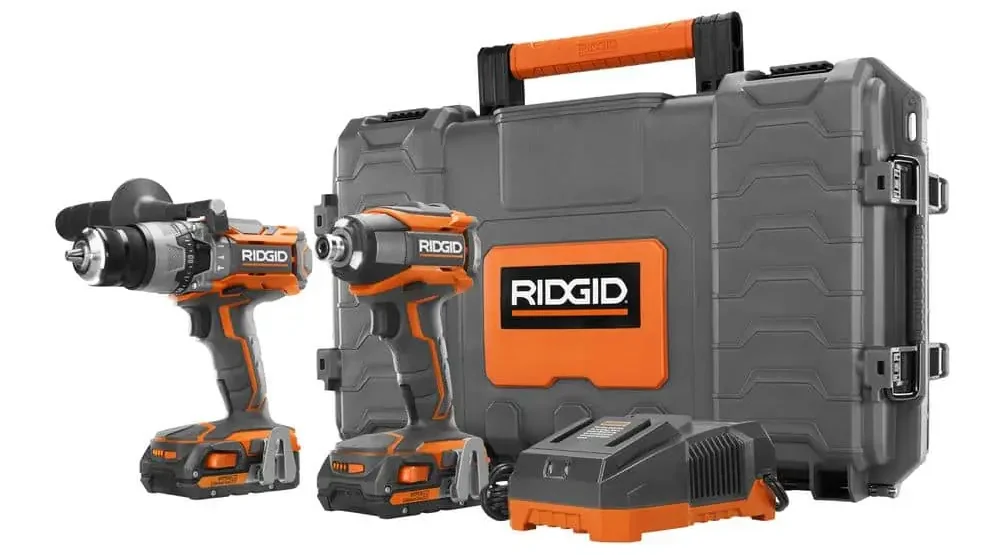
The RIDGID R8611503 18V 2-Speed Hammer Drill, was one of the first tools in that collection. The drill was included as part of the RIDGID R9624SB 2PC GGEN5X Kit With Hard Case. The other tool included the kit was a RIDGID R86035 18V Impact Driver and included two 2Ah batteries, a charger, and a hard travel case. I purchased the kit with my own money through Direct Tools Factory Outlet. At the time, the combination of RIDGID’s Lifetime Service Agreement, the relatively lower cost of its batteries compared with competing platforms, and the opportunity to purchase tools through the manufacturer’s outlet at a significant discount made RIDGID an attractive platform to invest in.
I had also considered other major cordless tool brands, including Ryobi, DeWalt, Milwaukee, and Makita. The availability of Direct Tools Factory Outlet locations within driving distance ultimately helped tip the decision toward RIDGID. Being able to purchase blemished or factory-reconditioned tools at reduced prices gave the platform an additional long-term value proposition.
I was a first-time buyer in another sense, too. While I had owned tools before, I was now beginning a journey into woodworking and DIY home ownership. I didn’t really know what I didn’t know yet. I wasn’t expecting to become Bob Vila or Norm Abram overnight, and I understood there would be compromises and a learning curve along the way. What I needed was a capable, dependable tool that I could learn with and grow into. Five years later, that decision has held up remarkably well.
First Impressions
The drill arrived as part of a well-organized kit with a premium presentation. Once I opened the case, getting started was about as simple as it gets for a cordless power tool.
I placed one of the included batteries on the charger, and in just under an hour it was ready for its first assignment. After a quick review of the included multilingual user manual and safety information, there was nothing else standing between me and the first project.
My initial impression of the drill itself was positive. It felt solid and well built, and I immediately trusted the quality of the tool in my hands.
I also remember this purchase because of what it represented. This wasn’t just another tool I had bought to get a job done. It was the beginning of my transition toward becoming a DIY homeowner and aspiring woodworker. I had taken the time to think about what I expected a tool to do, what it would cost to purchase, how much it would cost to maintain, and how long I expected it to last before eventually needing replacement.
For that reason, this drill has always had a somewhat special place on my workbench.
Learning the Drill
The drill was immediately usable, but there was a small learning curve, particularly for someone who was relatively new to using a drill with selectable torque settings.
The drill has enough power that selecting too high a torque setting can easily result in driving screws farther into the material than intended. When working with wood, especially as a new user, it is easy to overdrive a screw and bury it deeper than you want.
The solution is simple: start with a lower torque setting and gradually increase it until you find the setting that gives you the desired result.
That is not really a criticism of the drill. It is more a matter of understanding the capabilities of the tool and learning how to use them appropriately.
I would describe this drill as a medium-duty tool for both drilling and driving. It is capable enough for a broad range of DIY & Home Remodleing Projects and woodworking tasks, but like any tool, it has limits.
One thing that did surprise me was just how powerful it could be.
This drill has enough torque that, if you’re not prepared for it, it can potentially twist itself right out of your hand. That can be an unpleasant lesson for an inexperienced user. Anyone new to using a powerful cordless drill should take some time to become familiar with the tool and its behavior before putting it under heavy load.
Once I became familiar with it, however, that power became an asset rather than a concern.
Real-World Use
Over the past five years, this drill has become a foundational tool in my workshop and home DIY work.
Depending on the project, a drill can be either the primary tool or a supporting tool, but there are very few projects where having a drill available isn’t useful. For me, this particular hammer drill has become my go-to drill for roughly 90 percent of my home DIY & Home Remodeling Projects.
That doesn’t mean it is the right tool for every job.
The hammer function makes it possible to drill into concrete for smaller tasks, such as installing the occasional Tapcon screw. However, when the job involves repetitive concrete drilling or larger-diameter holes, the rotary hammer drill is a much better choice.
I learned that lesson through experience.
There was one occasion when I felt this drill underperformed. Looking back, however, the problem wasn’t really the drill. I was asking it to do something it wasn’t designed to do.
That experience led me to purchase a Ridgid R86711 SDS-Pluse 18 Volt Rotary Hammer Drill. Once I had the appropriate tool for the job, the difference was clear. Using the hammer drill for repetitive, larger-diameter concrete 3/8″ lag-anker bolts back to back would have added friction to the workflow, made the work more difficult, and taken longer to complete.
That experience reinforced an important lesson that applies to virtually every tool: the performance of a tool is only part of the equation. The other part is choosing the correct tool for the task.
A hammer drill can be extremely capable, but it isn’t a substitute for a rotary hammer when the job calls for one.
For woodworking, the drill has been particularly useful. When drilling into softwood and hardwood using Brad Point drill bits or the Porter-Cable Quick Pocket Hole Joinery System, the combination of the drill’s power and controllability makes the workflow significantly smoother.
This is where the drill has really earned its place in my workshop. It isn’t necessarily the most specialized tool I own, but it is one of the tools I reach for most often.
Long-Term Product Evaluation at a Glance
Evaluation Area
Year 1
Year 2-3
Year 5
Overall Performance
Build Quality & Durability
Reliability
Ease of Use
Features & Functionality
Long-Term Experience
Value Over Time
*See How I Review Products for an explanation of my evaluation system.
These categories represent the key areas I focus on when evaluating product longevity. Each one plays a role in determining my overall long-term satisfaction.
Five Years of Ownership
This is where my opinion of the drill has been confirmed. After more than five years of ownership and what I would consider above-average consumer use, the drill is still going strong.
My opinion of the drill hasn’t changed significantly since those first days of ownership. It has remained a reliable workhorse from day one. If anything, the drill’s performance improved after its initial break-in period and has remained consistent ever since.
I have not noticed any meaningful decline in performance over the five years I’ve owned it.
That consistency matters more to me than having the latest model or the most powerful tool available.
The drill has been used regularly, including outside in Florida’s heat, where summer temperatures can reach around 100 degrees. Despite those conditions and years of use, it has continued to perform reliably.
I can think of only one occasion when it failed to perform as I expected, and as I mentioned earlier, that was ultimately because I was asking it to perform a job better suited to a different tool.
There have been no unusual maintenance requirements, no unexpected repairs, and no reliability problems that have caused me to question whether I could depend on it.
That is a strong track record for a tool that has been part of my workshop for more than five years.
The Downsides
No tool is perfect, and there are a few things worth considering.
The biggest issue I’ve noticed is weight and fatigue during extended use.
The drill can become tiring to hold over longer periods, particularly in the thumb and wrist. This becomes more noticeable when using the larger 9Ah batteries. The additional battery capacity is useful, but it also adds weight to an already substantial tool.
That isn’t necessarily a problem for short tasks, but if you’re spending a long period drilling or driving overhead or working in awkward positions, the weight can become noticeable.
The other consideration is that this is a powerful drill.
For an experienced user, that power is generally a benefit. For someone new to cordless drills, however, it is something to respect. The combination of high torque and the selectable clutch settings means that a new user should spend some time learning how the drill responds before immediately putting it to work on a demanding project.
Neither of these issues has changed my overall opinion of the drill, but they are worth knowing before purchasing one.
The Right Tool for the Right Job
One of the most important things I’ve learned from owning this drill is that having a good tool isn’t enough. You also have to know when that tool is appropriate for the job.
This drill has become an essential part of my workshop because it handles such a broad range of tasks. But its usefulness doesn’t mean it should be used for everything.
For general drilling and driving, it has been an exceptionally dependable tool. For smaller concrete anchor holes, the hammer function is useful. For repetitive concrete drilling or larger holes, I reach for a rotary hammer instead.
That distinction is important because it is easy to blame a tool when a job goes poorly, when the real problem is sometimes that the wrong tool was selected.
In my experience, this drill has performed as advertised when used within its intended capabilities. The key is understanding where those capabilities end.
Would I Buy It Again?
Without hesitation. If this drill disappeared from my workshop tomorrow, I would immediately buy another one.
In fact, I have enough confidence in the design and reliability of this particular generation that I would even consider purchasing a factory-reconditioned example if production were discontinued and I needed a replacement. That is probably the strongest endorsement I can give any tool.
The drill has become a reliable workhorse that I reach for regularly. It has performed consistently for more than five years, required no unusual maintenance, and has shown no meaningful decline in performance.
Even though I was able to purchase the original kit at a significant discount through Direct Tools Factory Outlet, I believe the drill was worth the money even if I had been required to pay full big-box-store pricing.
The fact that I would willingly spend my own money on it again after five years of ownership tells me everything I need to know about the value I received from this tool.
Who Is This Drill For?
I think this drill is particularly well suited to DIY homeowners, maker hobbyists, and weekend woodworkers who want a capable cordless drill that can serve as a primary tool across a wide range of projects.
It is also a reasonable choice for someone beginning to build a cordless tool collection, particularly if they are interested in investing in the RIDGID 18V Powertools and value the combination of tool availability, battery compatibility, and RIDGID’s Lifetime Service Agreement.
That said, I would not recommend choosing a tool platform based solely on one drill. The value of a cordless ecosystem comes from the tools you eventually add to it. My decision to invest in RIDGID was influenced not only by this drill but also by the overall cost of entry, battery pricing, service agreement, and the availability of discounted tools through Direct Tools Factory Outlet.
For a beginner, I would also recommend spending some time learning how to use the drill’s torque settings and becoming familiar with its power before tackling demanding work.
And, most importantly, know when to use something else.
If your projects regularly involve large-diameter holes in concrete or repetitive masonry work, this is not the tool I would choose. A dedicated SDS-Plus rotary hammer is a much better fit.
For general drilling, driving, woodworking, and everyday DIY work, however, this drill has proven itself to be a dependable and versatile member of my workshop.
Final Thoughts
After more than five years of ownership, my overall take on the RIDGID 18V 2-Speed Hammer Drill is straightforward: this has been an exceptionally reliable primary tool that has consistently performed the work I’ve asked it to do. It was one of the first tools I purchased when I began building my long-term DIY and woodworking tool collection, and it has remained one of the tools I reach for most often.
Its performance has remained consistent. It has survived years of regular use, including demanding work in Florida’s heat. It has required no unusual maintenance, and I have seen no meaningful decline in performance. The drill isn’t the right tool for every job, and its weight can become tiring during extended use, especially with larger batteries. It also has enough power to surprise an inexperienced user. But those are reasonable limitations for a powerful, medium-duty cordless hammer drill.
The more important question is whether it has earned my trust. It has. After five years, I still trust this drill to be there when I need it. If it disappeared tomorrow, I wouldn’t shop around looking for something better. I would buy another one.
Would I spend my own money on this drill again? Absolutely. Without hesitation.
It’s easy to recommend something when you aren’t the one paying for it. It’s easy to praise a product after using it for a few days and then give it back. It’s harder to answer the same question after you’ve owned it for years, used it on real projects, dealt with its limitations, and seen how it holds up over time.
Would I make the same purchase again?
Without hesitation.
- DIY Home Owner
- Maker Hobbyists
- Weekend Woodworker
- Professional Contractor