The Definitive History of the Tuscola & Saginaw Bay Railway Inc. 1977-2006
Home |
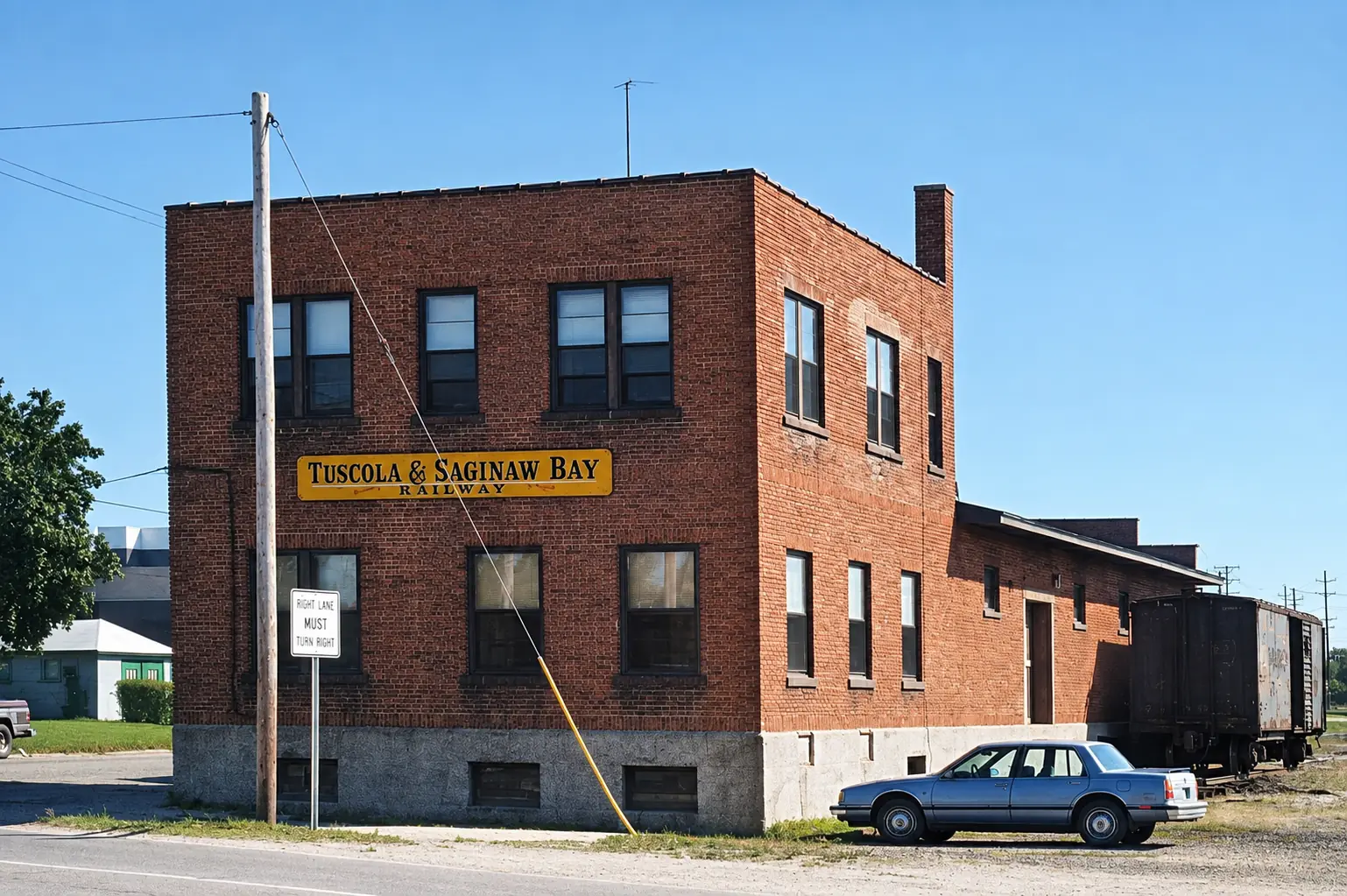
This article is a dynamically growing, foundational piece of content focused on providing historical accuracy with details. I'm not a professional historian, just a railroad enthusiast. If you can contribute to the accuracy and growth of this content, or have relevant documents, images, or knowledge of the Tuscola & Saginaw Bay Railway, please Contact Me. I don't always get things right, but I want to.
- Last Updated: August 29, 2026
- This article will update when progress is made.
Structures, Facilities and Assets Map
Structures, Facilities and Asset Locations By City
The Tuscola & Saginaw Bay Railway owned, rented or leased a number of railroad facilities across its network in Michigan. This included it’s headquarters, engine servicing facilities, and various transload stations for different materials and other assists. Each of these facilities were integral to the railway’s business strategy. A strategy of connecting long-distance rail freight to local industries and trucking partners throughout Michigan.
Cadillac
Cadillac is located in central Wexford County in Michigan’s northern Lower Peninsula and served as the county’s principal commercial and industrial center during the TSBY era. The city had a relatively stable population during this period, with approximately 10,200 residents in 1980, 10,100 in 1990, and 10,000 in 2000. Cadillac’s economy had evolved considerably from its nineteenth-century dependence on lumbering. By 1977, manufacturing was a major part of the local economy, supported by Cadillac’s long-established woodworking, metalworking, fabrication, and automotive-related industries.
Tourism was also becoming increasingly important, benefiting from the area’s lakes, forests, winter recreation, and proximity to the Manistee National Forest. Cadillac therefore remained an important employment and service center for the surrounding rural communities of Wexford County.
The Railroad and Cadillac
Rail transportation was fundamental to Cadillac’s development, with both the Grand Rapids & Indiana and Ann Arbor railroads serving the community by the early twentieth century. By 1977, the railroad system had become more complicated. Michigan Northern Railway operated the former Grand Rapids & Indiana route through Cadillac under an agreement with the State of Michigan and also operated the former Ann Arbor line extending east toward Alma. Michigan Northern’s headquarters was located in Cadillac, making the community an important operating center. Michigan Department of Transportation records also document substantial freight traffic originating and terminating at Cadillac during Michigan Northern’s early years.
TSBY’s role in Cadillac developed in stages. Beginning in 1982, TSBY operated the former Ann Arbor Railroad between Ann Arbor and Alma. In 1984, TSBY assumed operation of the former Michigan Northern lines north of Alma, including the route through Cadillac. This created a continuous TSBY-operated system connecting Cadillac with Alma and the railroad’s southern lines, while also providing access toward the Ann Arbor Railroad interchange network. The underlying railroad infrastructure was owned by the State of Michigan, which had acquired and preserved the lines to prevent abandonment. Cadillac consequently became an important junction and operating point within the TSBY system rather than simply a station along the route.
The importance of Cadillac continued after TSBY assumed the Michigan Northern operations. A 1995 federal filing specifically identifies Cadillac North Yard as part of the TSBY’s state-owned line between Cadillac and Petoskey. The railroad also maintained locomotive-service facilities in Cadillac, further demonstrating the community’s role as an operating center within the TSBY system.
Railroad-Owned and Shared Assets
- Cadillac Freight House – 225 N Lake St, Cadillac, MI 49601
The former Ann Arbor Railroad freight house was one of the identifiable railroad structures in downtown Cadillac. The building and address provide an especially useful reference point for documenting the transition from Michigan Northern to TSBY.
- Cadillac North Yard – 1345 N Mitchell St, Cadillac, MI 49601
Cadillac North Yard was a significant TSBY freight and operating facility. The 1995 Federal Records specifically identifies the yard as part of the TSBY’s state-owned Cadillac-Petoskey route. The exact extent of the yard and the individual tracks in use during the TSBY period require additional map-level research.
- Cadillac Locomotive Facilities – 1203 N Mitchell St, Cadillac, MI 49601
Cadillac retained locomotive-service facilities inherited from the earlier railroad system. Historical sources identify an engine house at 203 N. Mitchell Street, and photographs from the TSBY era show locomotives being serviced or stored there. A 2004 account describes TSBY locomotive 392 being taken north to the engine house after an excursion and identifies the facility as still standing. The available evidence strongly supports its continued railroad use during the TSBY era, although the precise evolution of the facility from its earlier Ann Arbor/Grand Rapids & Indiana configuration warrants further research.
- Coke Transload – 103 10th St, Cadillac, MI 49601
Historical accounts also indicate that a transload facility was constructed at the north end of the yard in 1997 for a short-lived potash movement originating near Hersey. As rail to truck transfer, this facility handled ABC coke (used in engine blocks) that was transferred to trucks for final delivery to a local manufacture.
Chesaning
Chesaning is a small village in southwestern Saginaw County along the Shiawassee River, approximately 16 miles north of Owosso. During the TSBY period, it remained a rural agricultural community surrounded by farms and smaller townships, while also serving as a local commercial center. The village had 2,656 residents in 1980, 2,567 in 1990, and 2,548 in 2000, averaging roughly 2,600 residents during the period. The surrounding Chesaning Township reached a population of 2,661 in 1980 before gradually declining, reflecting the broader population changes occurring across rural Saginaw County. Agriculture remained important to the local economy, particularly grain production and related farm services. The community’s location along the Shiawassee River and its long-established railroad connection had helped Chesaning develop as a local agricultural and commercial center.
The Railroad and Chesaning
Railroad service had been important to Chesaning since the nineteenth century, when the Jackson, Lansing & Saginaw Railroad reached the village. The line later became part of the Michigan Central, New York Central, and Penn Central systems and connected Chesaning with Owosso to the south and the Saginaw area to the north. By the 1970s, the line was part of the Penn Central system and was threatened by the railroad’s financial problems and proposed abandonments. Federal records from 1973 show that Chesaning generated 249 carloads of traffic, making it one of the more active stations on the branch. The local Chamber of Commerce argued that continued rail service was essential to area businesses and agriculture.
TSBY became the operator of the Owosso-Saginaw branch during the 1980s as Michigan worked to preserve portions of the former New York Central system. The line north of Owosso through Chesaning eventually became one of the smaller branches operated by TSBY. Although the portion north of Chesaning toward St. Charles was abandoned in 1991, TSBY continued operating the remaining line between Owosso and the Chesaning area. By the final years of TSBY operation, the branch extended north to approximately Fergus Road, just north of Chesaning.
Railroad-Owned and Shared Assets
- Railroad Right-of-Way and Track Facilities
The principal TSBY-owned/operated assets in Chesaning were the railroad infrastructure itself, including the state-owned right-of-way, main track, and a small yard/track arrangement that served the Chesing Grain Elevator. The line remained in TSBY operation through the end of the company’s tenure in 2006.
Historical mapping indicates that the yard was relatively small, and the exact number and arrangement of tracks during TSBY operation have not yet been established.
Clare
Clare is located in central Michigan’s Lower Peninsula, primarily in Clare County with a small portion of the city extending into Isabella County. During the TSBY period, Clare was a small regional community whose population remained close to 3,000 residents. The 1980 census recorded about 3,300 residents, followed by approximately 3,021 in 1990 and 3,173 in 2000, giving the city an average population of roughly 3,165 during the period. Clare developed as a lumbering community in the late nineteenth century, but by the TSBY era its economy had become more diversified, with manufacturing, retail, agriculture, and transportation contributing to the local economy. Its location at the intersection of major highways and railroad routes helped Clare remain an important service center for the surrounding rural areas.
The Railroad and Clare
Clare’s importance to the railroad was established long before the TSBY was created. By the late nineteenth century, the community had become a junction between the Pere Marquette Railroad and the Ann Arbor Railroad, with the two lines crossing at the Clare Union Depot. The Pere Marquette route ran generally east-west through Clare, while the Ann Arbor line ran north-south toward Cadillac and Alma. This made Clare one of the more unusual railroad junctions in the region, and the community’s development remained closely associated with the two railroads.
By 1977, the two railroad routes had very different ownership and operating histories. The former Pere Marquette route was operated by Chesapeake & Ohio (C&O), while the former Ann Arbor route was operated by Michigan Interstate Railway under an agreement with the State of Michigan. When Michigan Interstate discontinued its northern operations in 1982, TSBY assumed operation of the former Ann Arbor line. TSBY trains subsequently passed directly through the center of Clare, connecting the community with Cadillac to the north and Owosso and the southern TSBY system to the east.
The C&O line through Clare remained active into the 1980s, but its future was increasingly uncertain. In January 1989, the Interstate Commerce Commission authorized CSX Transportation to abandon the former C&O line between Midland and a point approximately 2.5 miles east of Clare. On January 5, 1988, TSBY purchased the 2.5 miles of the CSX line at Clare, preserving a short section of the former C&O route for local switching. This gave TSBY a physical presence at the Clare junction beyond simply operating the Ann Arbor line.
Railroad-Owned and Related Assets
- Clare Union Depot –201 W 4th St, Clare, MI 48617
The Clare Union Depot was built in 1895 at 314 W. Fifth Street as a joint facility for the Ann Arbor and Pere Marquette railroads. When passenger service ended in 1950, the building remained associated with the railroad and was subsequently used for storage and railroad maintenance purposes. During the TSBY era, the depot remained on railroad property and was eventually owned by TSBY. The City of Clare purchased the building from TSBY for $10,000 in 2005, shortly before the railroad was sold and renamed Great Lakes Central. The depot was subsequently moved approximately 900 feet to Fourth Street, where it was eventually restored and reopened as a museum and community center.
- Clare Railroad Junction – 43.819077, -84.774006
The railroad junction in Clare remained an important operating point during the TSBY era. The former Ann Arbor line crossed the former Pere Marquette/C&O line at the depot, creating an interchange point between two historically separate railroad routes. After the C&O line was abandoned east of Clare, TSBY’s 1988 purchase of approximately 2.5 miles of the former CSX line preserved a short section for local switching. The original crossings interlocking infrastructure was subsequently removed, but the surviving portion of the former C&O route stayed part of TSBY’s local switching operation.
- TSBY Clare Short Line
The 2.5-mile segment purchased from CSX in 1988 is one of the clearest examples of TSBY actually acquiring railroad property, rather than simply operating State-owned track. The purchase allowed TSBY to retain access to local industries along the remaining portion of the former C&O route after the remainder of the line was abandoned to eventually become the Pere Marquette Trail.
Durand
Durand is located in eastern Shiawassee County, roughly midway between Flint and Lansing. During the TSBY period, the city remained a small community of about 4,000 residents, with populations of 4,241 in 1980, 4,283 in 1990, and 3,933 in 2000, an average of approximately 4,150 residents. Durand’s identity was closely tied to railroading. The community developed around the railroad in the nineteenth century and became an important junction where the Grand Trunk Western and Ann Arbor railroads crossed. By the late twentieth century, manufacturing, agriculture, and local commerce remained important, but Durand’s railroad heritage continued to be one of its defining characteristics.
The Railroad and Durand
Railroading was central to Durand’s development long before TSBY arrived. The Grand Trunk Western’s main line through Durand crossed the Ann Arbor Railroad, making the community an important junction. By 1977, however, the character of that railroad activity was changing. Grand Trunk Western remained the dominant railroad through town, while TSBY operated the former Ann Arbor Railroad route through Durand as part of its expanding Michigan network. The two railroads therefore shared an important physical junction even though their ownership and operations remained separate.
Durand became particularly important to TSBY because the Ann Arbor route provided the railroad with a connection to the Grand Trunk Western system. TSBY’s route extended south from Durand toward Howell and Ann Arbor and north toward Owosso and the remainder of its system. By the 1990s and early 2000s, Durand was also an interchange point between TSBY and Grand Trunk Western.
The physical crossing became particularly significant in 1987. Following a collision, Grand Trunk Western removed the railroad diamonds at the crossing in December of that year. TSBY could no longer cross directly over the Grand Trunk Western main line and instead had to wye its trains through Durand using the Grand Trunk Western main line. TSBY and the city considered legal action to have the diamonds restored. This illustrates the operational importance of the Durand junction to TSBY and the railroad’s dependence on another carrier’s infrastructure to maintain its route.
Railroad-Owned and Related Assets
- TSBY Railroad Right-of-Way and Track
The principal TSBY asset in Durand was the former Ann Arbor Railroad right-of-way and associated track. Much of the former Ann Arbor route north of Ann Arbor became part of the TSBY system, and the line through Durand remained in operation throughout the TSBY era. The railroad infrastructure was primarily State-owned, with TSBY operating the line under its agreements with Michigan.
- Durand Railroad Junction and Interchange
The junction where the TSBY route crossed the Grand Trunk Western was the most important railroad location in Durand from the TSBY perspective. It provided TSBY with access to the Grand Trunk Western network and eventually became an established interchange point. The physical diamond crossing was removed in 1987, requiring TSBY to use the Grand Trunk Western main line to wye its trains through the junction.
- TSBY Locomotive Connection to Durand
Durand also had a notable connection to TSBY’s locomotive fleet. TSBY GP35 No. 390 carried the name “City of Durand.” The locomotive had originally been built for the Ann Arbor Railroad as No. 390 and was acquired by TSBY in 1977. Its name provides a direct connection between TSBY’s original Ann Arbor Railroad heritage and the community of Durand.
Grawn
Grawn is an unincorporated community in Blair Township in Grand Traverse County, approximately eight miles southeast of Traverse City. During the TSBY period, it was a small rural community surrounded by agricultural and fruit-growing land. Grawn developed as a railroad community after the Pere Marquette Railway reached the area in 1890, and fruit production became an important part of the surrounding economy. Because Grawn was not incorporated and did not have its own municipal government, reliable population figures for the community during 1977–2006 are difficult to establish. The present census-designated place boundaries were not created until 2010, so I would avoid assigning a specific population to Grawn for the TSBY period. The surrounding area was nevertheless experiencing increasing suburban growth as Traverse City expanded southward.
The Railroad and Grawn
Grawn’s railroad history began with the Pere Marquette Railway, which established the community as a station on its line between Traverse City and points west. The former Pere Marquette route between Grawn and Williamsburg, through Traverse City, later became part of the Chesapeake & Ohio system. By the beginning of the TSBY period, the line was therefore an established freight railroad serving the agricultural and lumber-producing region around Grawn.
The State of Michigan purchased the former C&O line in 1981, and Michigan Northern Railway subsequently operated it. Michigan Northern’s operation of the Grawn-Williamsburg segment ended September 30, 1984. Beginning October 1, 1984, TSBY became the operator of the state-owned line from Grawn to Williamsburg, including the railroad through Traverse City. This placed Grawn at the western end of a TSBY branch that connected directly with the company’s important Traverse City operations.
Grawn was more than a station on this branch. The community had railroad-served lumber and fruit-processing industries, and TSBY continued serving those customers after taking over the line from Michigan Northern. The railroad’s significance was therefore tied primarily to local freight service, rather than to a major railroad yard or interchange. The line itself remained state-owned, TSBY operated it rather than acquiring the corridor as its own property.
Railroad-Owned and Related Assets
- Grawn Railroad Right-of-Way and Track
The principal TSBY railroad asset at Grawn was the former Pere Marquette/C&O railroad line. The State of Michigan purchased the C&O segment in 1981, and TSBY operated it beginning in 1984. The line continued west from Grawn toward Williamsburg and east toward Traverse City. It should therefore be described as state-owned railroad infrastructure operated by TSBY, rather than as TSBY-owned property.
- Grawn Runaround/Passing Track – 44.664711, -85.693715
Grawn also had a runaround or passing track that allowed locomotives to work cars and return to the main line. Later railroad accounts specifically identify a runaround track in Grawn, and the physical arrangement remained recognizable after the TSBY era. Although the available evidence does not yet establish the exact configuration of this track in 1984, its existence is consistent with Grawn’s role as a freight-serving location.
Howell
Howell is the county seat of Livingston County and was a small but growing regional center during the TSBY period. The city was located approximately midway between Lansing and Detroit and served the surrounding agricultural communities as a commercial, governmental, and transportation center. By the late twentieth century, Howell’s location along major highways and its proximity to the Detroit metropolitan area were contributing to population growth and suburban development. The railroad remained an important part of Howell’s historical identity even though passenger service had ended decades before the TSBY era.
The Railroad and Howell
Railroad service reached Howell in the nineteenth century and became an important factor in the city’s economic development. The Toledo, Ann Arbor and Northern Railroad reached Howell in 1885, and its brick depot was constructed in 1886. The railroad was reorganized as the Ann Arbor Railroad in 1895 and operated a north-south route through Howell connecting Toledo with the communities of Michigan’s Lower Peninsula and ultimately Frankfort and Elberta. The depot area developed into a substantial railroad complex containing a freight house, water tower, engine house, loading platform, and covered coal trestle. Sidings extended south of the depot to serve a flour mill, feed mill, grain elevator, and lumber yard.
By 1977, the former Ann Arbor Railroad was no longer an independent railroad. The State of Michigan had acquired the railroad’s infrastructure following its bankruptcy, and Michigan Interstate Railway became the designated operator in 1977. TSBY subsequently assumed operation of the Ann Arbor line between Ann Arbor and Alma in 1982. Howell therefore became part of the TSBY system during the 1980s, with TSBY operating the railroad through the community rather than owning the underlying State-owned corridor.
Howell’s position on the former Ann Arbor route made it a useful freight location within TSBY’s system. The existing yard and industrial sidings provided access to local businesses, while the railroad connected Howell southward toward Ann Arbor and northward toward Durand, Owosso, and the remainder of the TSBY network. The historical record confirms that the railroad’s sidings remained identifiable in the yard west of the depot, although determining exactly which sidings were actively used by TSBY and which industries received TSBY service requires separate customer-level research.
Railroad-Owned and Related Assets
- Former Ann Arbor Railroad Right-of-Way and Track
The principal TSBY presence in Howell was the former Ann Arbor Railroad right-of-way and associated track. The underlying railroad property was part of the State of Michigan’s preserved railroad system; TSBY was the designated operator and infrastructure was not TSBY-owned property.
- Howell Railroad Yard and Sidings
The railroad complex west of the depot included multiple sidings and industrial tracks. Historical sources indicate that these tracks served a flour mill, feed mill, grain elevator, and lumber yard. Some of the sidings remained in existence in the yard during the later twentieth century. The available evidence establishes the physical railroad facilities, but we should not assume that every historic siding remained active or served the same customers during the TSBY period.
- Howell Ann Arbor Railroad Depot – 128 Wetmore St, Howell, MI 48843
The historic Ann Arbor depot remains an important part of Howell’s railroad story and is historically important but was privately owned by the Howell Area Historical Society throughout the TSBY era. The building was constructed in 1886 and was purchased by the Howell Area Historical Society in 1970, before the TSBY era. It remained standing throughout the TSBY period, but by then it was being used as a community museum rather than as a TSBY railroad facility.
Middleton
Middleton is an unincorporated community in Fulton Township in central Gratiot County, approximately 10 miles northwest of Ithaca and about 12 miles northeast of St. Johns. Unlike larger communities such as Alma or Ithaca, Middleton remained a small rural settlement throughout the TSBY period. Because Middleton was not incorporated as a city or village and was not separately enumerated in the modern census, a reliable population figure for 1977-2006 is not available. Its identity remained closely connected to agriculture and the railroad, which had been responsible for the community’s development in the nineteenth century. Historical accounts specifically note that the railroad influenced the creation of Middleton, which was platted in 1887.
The Railroad and Middleton
Railroad service was fundamental to Middleton from the beginning. The community developed around the railroad, and nineteenth-century records identify Middleton as having a railroad station, post office, and a railway express agency office. By 1895, the community had approximately 221 residents. The railroad made Middleton a local shipping point and helped establish it as an agricultural center in the surrounding rural area.
By the beginning of the TSBY period, the railroad through Middleton was part of the Grand Trunk Western system. The line was originally constructed by the Toledo, Saginaw & Muskegon Railway and eventually became part of Grand Trunk Western. GTW continued operating the line into the early 1980s, but the railroad sought abandonment of the route as traffic declined. Rather than allowing the entire line to disappear, TSBY negotiated to acquire the eastern portion.
In August 1983, TSBY purchased approximately 12 miles of the former Grand Trunk Western Greenville Subdivision between Middleton and Ashley. This was significant because it was not simply another State-owned line operated by TSBY. In this case, TSBY actually acquired the railroad property. The transaction preserved the railroad connection between Middleton and Ashley and created one of the relatively small portions of the TSBY system that the company owned outright.
The portion of the former line west of Middleton was treated differently. GTW’s tracks between Middleton and Carson City were subsequently acquired by a private landowner, while the more distant portion toward Muskegon was physically removed. This left Middleton at the western end of the TSBY-owned railroad extending to Ashley. The line provided TSBY with a connection to the larger railroad network at Ashley, where it connected with the former Ann Arbor route.
Middleton appears to have been primarily an agricultural freight location, rather than a major railroad operating center. The surviving evidence points to grain traffic as an important component of the railroad’s business. The later history of the line also reinforces Middleton’s importance as a freight connection. After TSBY was succeeded by Great Lakes Central, the Middleton branch continued to serve the agricultural industry, including the large Michigan Agricultural Commodities facility. Contemporary Gratiot County economic-development material identifies MAC in Middleton as a major rail customer.
Railroad-Owned and Related Assets
- TSBY Middleton-Ashley Branch – 43.183574, -84.708817
The most important TSBY asset at Middleton was the approximately 12-mile railroad between Middleton and Ashley. Unlike many of the other lines operated by TSBY, this section was actually purchased by TSBY from Grand Trunk Western in 1983. The acquisition preserved the railroad east of Middleton after GTW sought to abandon the route.
The branch remained associated with TSBY through the remainder of the company’s existence and subsequently became part of the Great Lakes Central system.
- Middleton Railroad Station and Track Facilities
Middleton’s railroad station was an important part of the community’s earlier history, but I have not found evidence that the historic depot remained an owned railroad facility during the TSBY period. The available historical record confirms that Middleton had a railroad depot and station during the nineteenth and early twentieth centuries, but additional research is needed to establish when the building was removed or ceased railroad use.
- Middleton Railroad Yard / Agricultural Track Facilities – 43.183536, -84.712086
Middleton’s railroad infrastructure included track serving the agricultural businesses located around the railroad. Modern railroad sources identify the Middleton elevator complex at approximately 306 N. Caroline Street, but the available evidence does not establish that the present facility or its exact track arrangement existed in the same form during the TSBY era.
Owosso
Owosso is located in central Shiawassee County along the Shiawassee River, approximately 25 miles northeast of Lansing and 30 miles southeast of Saginaw. It is the county seat and was the largest community in the county during the TSBY period. Owosso had 16,455 residents in 1980, 16,322 in 1990, and 15,713 in 2000, averaging approximately 16,200 residents during those three census years. The city developed as an industrial and transportation center, with manufacturing, agriculture, and railroading playing important roles in its economy. By the TSBY era, Owosso’s railroad importance was particularly significant because several historically separate railroad routes converged there.
The Railroad and Owosso
Railroading was fundamental to Owosso’s development. The Toledo, Ann Arbor & North Michigan Railroad reached the community in 1884 and established Owosso as a division point, with railroad yards and locomotive facilities. Other railroads, including the Grand Trunk Western and Michigan Central/New York Central, also established important facilities in the city. By the twentieth century, Owosso had become one of the more important railroad centers in central Michigan.
The railroad landscape changed substantially before TSBY was created. The former Ann Arbor Railroad entered bankruptcy in 1973, and the State of Michigan acquired portions of its infrastructure as part of the state’s effort to preserve rail service. Michigan Interstate Railway became the designated operator of the Ann Arbor system in 1977. In October 1982, Michigan Interstate stopped operating the Ann Arbor route north of Ann Arbor, and TSBY assumed operation of the former Ann Arbor line between Ann Arbor and Alma.
Owosso subsequently became an important northern operating point for TSBY. In the same period, TSBY was selected to operate the former New York Central/Penn Central Saginaw Branch between Owosso and the Saginaw area. This gave TSBY two important routes meeting at Owosso: the former Ann Arbor route running north toward Cadillac and south toward Ann Arbor, and the former Saginaw Branch running west toward Chesaning and Saginaw. The combination made Owosso much more than a station on the TSBY system – it became a major operating and connecting point.
The distinction between ownership and operation is particularly important at Owosso. Much of the railroad infrastructure operated by TSBY was owned by the State of Michigan, rather than by TSBY itself. TSBY’s role was to operate and maintain the state-owned lines under its agreements with the Michigan Department of Transportation.
Owosso Railroad Heritage During the TSBY Era
Owosso also became increasingly important as a center for railroad preservation during the TSBY period. In 1982, Pere Marquette Berkshire No. 1225 was moved to the former Ann Arbor Railroad backshop in Owosso, where restoration continued until the locomotive moved under its own power in 1985. The locomotive later became closely associated with TSBY excursion operations and the community’s railroad identity. This was magnified when the 1225 became the star of the 2004 animated Christmas adventure film The Polar Express.
This preservation activity is separate from TSBY’s freight operation, but it is worth mentioning because the two railroad stories overlapped physically in Owosso. The former Ann Arbor facilities provided the setting for both continuing railroad operations and the preservation movement that eventually produced the Steam Railroading Institute.
Railroad-Owned and Related Assets
- Former Ann Arbor Railroad Right-of-Way and Track
The principal TSBY infrastructure in Owosso included the former Ann Arbor Railroad route. TSBY operated the line through the city as part of its Ann Arbor-Alma route beginning in 1982. The underlying property was part of Michigan’s preserved railroad system.
- Owosso-Saginaw Branch
TSBY also operated the former New York Central/Penn Central Saginaw Branch west from Owosso. The branch became an important part of TSBY’s network during the 1980s and ultimately connected Owosso with Chesaning, St. Charles, and the Saginaw area. This is the line that later became the basis of the Great Lakes Central Owosso-Oakley branch.
- Owosso Railroad Yard and Junction – 600 Oakwood Ave, Owosso, MI 48867
Owosso contained a complicated network of yards, junctions, and connecting tracks belonging historically to several railroads. The Ann Arbor, Grand Trunk Western, and New York Central had all operated in the community, and the lines crossed or connected at several locations. Historical railroad mapping shows substantial railroad facilities around the city, including the former Grand Trunk Western yard and facilities east of the GTW/Michigan Central crossing.
- Owosso Railroad Shops / Former Ann Arbor Steam Shops
One of the most historically important railroad properties in Owosso is the former Ann Arbor Railroad steam shops and roundhouse. The facility was associated with the Ann Arbor Railroad long before TSBY. During the TSBY era, however, the site remained an important railroad maintenance complex. The property subsequently became the home of the Michigan State Trust for Railway Preservation and is now operated by the Steam Railroading Institute. The organization confirms that the former Ann Arbor steam backshop in Owosso was used for restoration of Pere Marquette 1225 beginning in 1982.
Petoskey
Petoskey is located in northwest Michigan on the southern shore of Little Traverse Bay, approximately 60 miles north of Traverse City. It is the county seat of Emmet County and was the largest community in the county during the TSBY period. The city had 7,202 residents in 1980, 6,147 in 1990, and 6,080 in 2000, averaging approximately 6,500 residents during those census years. During 1977–2006, Petoskey was primarily a regional commercial center and resort community, with tourism, retail, services, and nearby agricultural activity contributing to the local economy. Its location on Little Traverse Bay and its proximity to the resort communities of Harbor Springs, Bay View, and Walloon Lake gave Petoskey an important role in northern Michigan tourism. Railroading had historically been instrumental in opening the area to both commerce and tourism.
The Railroad and Petoskey
Railroad service reached Petoskey in December 1873 when the Grand Rapids & Indiana Railroad completed its line to the community. The railroad transformed Petoskey from a small settlement into an important transportation and resort center. The GR&I promoted northern Michigan tourism aggressively, and Petoskey became an important destination for visitors traveling to the Little Traverse Bay region.
By the beginning of the TSBY period, the former GR&I route was part of the Pennsylvania Railroad system and subsequently Penn Central. When Penn Central sought to abandon the northern Michigan line, the State of Michigan intervened to preserve rail service. Michigan Northern Railway began operating the former GR&I route from Grand Rapids through Petoskey to Mackinaw City in 1976 under an agreement with the State.
This arrangement changed in 1984. Michigan terminated its operating agreement with Michigan Northern after the railroad’s financial and operating difficulties, and TSBY became the designated operator of the State-owned railroad between Reed City and Petoskey. A 1995 Interstate Commerce Commission filing specifically identifies TSBY as the designated operator of the Reed City-Petoskey segment of the former GR&I North line.
This made Petoskey the northern terminus of one of the most important State-owned portions of the TSBY system. TSBY’s railroad continued south from Petoskey through Walton Junction and Cadillac, connecting Petoskey with the company’s Traverse City and southern Michigan operations.
Petoskey and the TSBY Operating System
Petoskey’s importance to TSBY was primarily its position at the northern end of the railroad’s State-owned route. TSBY did not simply provide local freight service to Petoskey; it operated the railroad connecting the community with Cadillac, Traverse City, and points farther south.
The history of the line also illustrates the complicated ownership structure of the TSBY system. The former GR&I railroad had passed through Pennsylvania Railroad and Penn Central ownership before Michigan intervened to preserve the route. Michigan Northern initially operated the State’s railroad under contract, followed by TSBY beginning in 1984. Thus, the physical railroad at Petoskey had a long ownership history, while TSBY’s role was primarily that of operator of State-owned infrastructure.
TSBY locomotive GP35 No. 388 was named “City of Petoskey.” This provides a particularly direct connection between the railroad and the community.
Railroad-Owned and Related Assets
- Petoskey-Reed City Railroad Line
The most important TSBY asset at Petoskey was the railroad itself. TSBY operated the former GR&I route between Reed City and Petoskey beginning in 1984. This was State-owned railroad infrastructure operated by TSBY, not railroad property owned outright by TSBY. The line connected Petoskey southward through Cadillac and Reed City with the remainder of the TSBY network. This made Petoskey the northern endpoint of a major TSBY operating district rather than simply another local station.
- Petoskey Railroad Yard and Tracks – 45.370578, -84.958419
Petoskey retained railroad yard and switching trackage associated with the former GR&I route. The available historical evidence confirms railroad freight facilities in the vicinity of the former passenger depot and along the waterfront, but I have not yet found sufficient evidence to establish the exact configuration or extent of TSBY’s active yard during 1977–2006. I former lines were repurposed into the Downtown Greenway project.
- Grand Rapids & Indiana Depot – 9 Pennsylvania Plaza, Petoskey, MI 49770
The historic GR&I passenger depot remained standing during the TSBY period. The depot was constructed around 1902 as part of the GR&I’s effort to improve its northern Michigan passenger facilities. However, the depot was not a TSBY-owned facility. It was a passenger facility inherited from the earlier railroad system and had ceased serving its original passenger function before TSBY’s involvement. It remains an excellent physical landmark for identifying the historic railroad location in Google Maps.
- Chicago & West Michigan / Pere Marquette Depot – 100 Depot Ct, Petoskey, MI 49770
The former Chicago & West Michigan Railroad depot, a second important railroad building that survives in Petoskey. Completed in 1892, the building later became part of the Pere Marquette and Chesapeake & Ohio systems. Passenger service ended in 1964, and the building was restored as the Little Traverse History Museum in 1974. This too mentioned as it is a historic railroad landmark, but it was never a TSBY asset.
Traverse City
Traverse City is located at the head of Grand Traverse Bay in northwestern Michigan’s Lower Peninsula and served as the county seat and principal commercial center of Grand Traverse County. During the TSBY period, the city itself had a population of roughly 15,000. The 1980 census recorded 15,516 residents, followed by 15,155 in 1990 and 14,532 in 2000. Although the city’s population declined modestly during these decades, the surrounding Grand Traverse County was growing rapidly, increasing from 54,899 residents in 1980 to 77,654 in 2000. Traverse City was therefore serving an expanding regional population while remaining an important center for agriculture, food processing, tourism, retail, health care, and other services. The area’s cherry industry and growing tourism economy were particularly important characteristics of the community during the TSBY era.
The Railroad and Traverse City
Railroads had played an important role in Traverse City’s development since the arrival of the Grand Rapids & Indiana in 1872. By 1977, however, the railroad’s role had changed substantially. Regular intercity passenger service had ended in 1966, leaving freight as the primary railroad function. Michigan Northern Railway operated the former Grand Rapids & Indiana Traverse City branch beginning in 1976. The State of Michigan subsequently acquired additional former Chesapeake & Ohio lines, including the route between Grawn, Traverse City, and Williamsburg. Effective October 1, 1984, Michigan Northern was replaced by the Tuscola & Saginaw Bay Railway as the designated operator of these state-owned lines.
For the TSBY, Traverse City was consequently more than another station on the railroad. It was an important operating and freight center at the northern end of its system. The railroad continued serving local industries while maintaining the inherited yard and terminal infrastructure. The TSBY also became involved in Traverse City’s growing tourism economy. Beginning in 1996, the Grand Traverse Dinner Train operated from the former Pere Marquette depot, using TSBY trackage for excursions toward Kingsley, Walton Junction, and Williamsburg. The dinner train operated until 2005 and provides particularly strong evidence of the TSBY’s continuing connection with Traverse City’s tourism industry.
Railroad-Owned and Shared Assets
- Boardman Yard – 260 E Twelfth St, Traverse City, MI 49684
Boardman Yard was the principal railroad yard serving Traverse City. The Pere Marquette and later Chesapeake & Ohio used the facility for freight operations, and the yard remained part of the railroad infrastructure inherited by the TSBY. Historical records identify a freight house, locomotive-service facilities, an engine house, water facilities, and a wye. TSBY locomotives and industrial switching activity are documented at the yard during the 1990s and 2000s.
- Boardman Yard Locomotive Facilities
Boardman Yard historically included locomotive-service facilities, an engine house, water facilities, and a turntable. These were inherited from earlier railroad operations. The existence of the facilities is well documented, but the precise location, condition and operational status of each component during the TSBY era should not be assumed without additional contemporary evidence.
- Boardman Wye – 44.751983, -85.620228
A wye extended from Boardman Yard toward the former Traverse City State Hospital. Historical sources report that the hospital received coal by rail for its boilers. The connection is well documented historically, although additional research is needed to establish precisely how much of this infrastructure remained in active use throughout the TSBY period.
- Former Pere Marquette Depot – 642 Railroad Pl, Traverse City, MI 49686
Completed in 1927, the former Pere Marquette passenger and freight depot remained an important railroad landmark during the TSBY period. Although regular passenger service had ended years earlier, the building remained associated with the railroad property. From 1996 through 2005, it served as the departure point for the Grand Traverse Dinner Train. The depot survives today, making 642 Railroad Place one of the easiest TSBY-era railroad locations in Traverse City to identify and visit.
Vassar
Vassar is located in southern Tuscola County along the Cass River, approximately 15 miles southeast of Saginaw and 10 miles west of Caro. During the TSBY period, Vassar was a small industrial and agricultural community with a population of approximately 3,000 residents. The city had 3,010 residents in 1980, 2,975 in 1990, and 2,979 in 2000, making an average of roughly 3,000 residents during the period. Agriculture, manufacturing, and local commerce remained important to the community, while the Cass River and the railroad had historically influenced Vassar’s development.
The Railroad and Vassar
Vassar deserves more attention than some of the smaller communities on this page because it represents the birthplace of TSBY’s original operating system. TSBY was incorporated in April 1977 and began operating in October of that year. The initial operation was centered in the Vassar area, where the company took over railroad operations on former New York Central/Penn Central lines. This original territory explains the company’s name: Tuscola and Saginaw Bay Railway reflected the geographic area in which the railroad initially operated.
The railroad’s Vassar operations also explain why the TSBY system eventually became much larger than its original territory. During the 1980s, the company expanded into the former Ann Arbor Railroad system, eventually connecting its original Vassar-area operations with the extensive railroad network reaching through Owosso, Cadillac, Traverse City, and Petoskey.
Railroading was particularly important to Vassar because the community developed as a railroad junction. The first railroad reached Vassar in 1873, and additional lines followed, eventually connecting the community with Bay City, Saginaw, Caro, and Port Huron. By the late nineteenth century, Michigan Central had established substantial facilities at Vassar, including a depot, roundhouse, turntable, and coal facilities. The railroad gave Vassar an important regional shipping position and supported the movement of agricultural products and manufactured goods.
By 1977, Vassar’s railroad system had changed considerably. The former Michigan Central routes had become part of the New York Central/Penn Central system and subsequently came under State of Michigan preservation efforts. When the State began subsidizing short-line railroad operations in 1977, TSBY was created specifically to operate railroad lines in the Vassar area. Michigan’s official railroad history records that TSBY began operations in the Vassar area on October 1, 1977.
Vassar was therefore one of the communities at the very beginning of TSBY’s history, rather than one that the railroad acquired later. The original TSBY system included the former New York Central lines extending from Vassar toward Millington and Munger, as well as the former Michigan Central routes toward Caro and Colling. TSBY also operated the Saginaw-area line from Vassar toward Richville.
This makes Vassar fundamentally different from locations such as Howell, Grawn, and Petoskey. At those locations, TSBY’s involvement developed through later contracts to operate State-owned railroad routes. Vassar was part of the original TSBY operating territory when the company began in 1977.
Railroad-Owned and Related Assets
- Vassar-Area Railroad Lines
The principal TSBY infrastructure at Vassar consisted of the railroad lines radiating from the community. TSBY operated former New York Central/Michigan Central infrastructure in the Vassar area beginning in 1977. The lines extended toward Millington and Munger, toward Colling, and toward Richville/Saginaw.
The important ownership distinction is that these were State-preserved railroad lines operated by TSBY, rather than railroad property that TSBY necessarily owned outright. The Michigan Railroad History record specifically describes the State’s acquisition and preservation of railroad lines and TSBY’s subsequent operating role.
- Vassar Railroad Junction – 43.366077, -83.573234
Vassar contained a significant railroad junction where historically separate railroad routes crossed. The former New York Central Bay City Branch crossed the former Pere Marquette/C&O route between Saginaw and Port Huron. The crossing was protected by an interlocking tower beginning in 1902. The tower was closed in 1965, and train-order functions were transferred to the C&O depot. By the TSBY period, the crossing remained an important physical feature even though the original tower was no longer operating.
- Yard and Railway Offices – S Sherman St &, E Huron Ave, Vassar, MI 48768
Vassar was the original headquarters of TSBY when it began operations in 1977. The company utilized the renovated 1890 Michigan Central Passenger Depot for its main office until it relocated the offices to Owosso in 1984. This location also served as an early Engine Servicing Facility.
Walton Junction
Walton Junction is an unincorporated community in Fife Lake Township, Grand Traverse County, immediately north of the Grand Traverse-Wexford County line. Unlike the other locations on this page, Walton Junction was not an incorporated city or village during the TSBY period. The community developed around the railroad beginning in 1872-1873 and was originally known as Walton Junction before the name was shortened to Walton. By 1977, very little of the original community remained, but the railroad junction itself remained an important operating location.
The Railroad and Walton Junction
Railroading was the reason Walton Junction existed. The Grand Rapids & Indiana Railroad established the junction in 1872 when its line north from Cadillac was connected with the branch to Traverse City. The resulting wye allowed trains to travel north toward Petoskey, south toward Cadillac, or northwest toward Traverse City. The Manistee & Northeastern Railroad later crossed the GR&I at Walton, further increasing the location’s importance as a railroad junction.
By the beginning of the TSBY era, the former GR&I routes were part of the State of Michigan’s railroad system and were being operated by Michigan Northern Railway. Michigan Northern operated the main line through Walton Junction as well as the branch west to Traverse City. When Michigan terminated its agreement with Michigan Northern in 1984, TSBY assumed operation of the State-owned railroad routes. This brought Walton Junction into the expanding TSBY system and made it an important connection between the railroad’s Cadillac-Petoskey route and its Traverse City branch. The importance of the junction continued throughout the TSBY period.
Railroad-Owned and Related Assets
- Walton Junction Wye – 44.527468, -85.398420
The most important railroad feature at Walton was the wye junction connecting the former GR&I main line with the Traverse City branch. The wye allowed locomotives and trains to change direction and provided the physical connection between the two TSBY routes.
The junction was not a TSBY-owned property in the conventional sense. The underlying railroad was State-owned, while TSBY served as the designated operator.
- Walton Junction Siding and Yard – 44.527337, -85.397539
Historical railroad records identify a siding and yard associated with Walton Junction. A 1935 railroad timetable identifies Walton Junction as a junction and yard location, while photographs from 2006 show only the main line, siding, and wye connection still in place.
- Walton Junction Depot
The original railroad community included a depot near the junction. Historical photographs document the depot and other buildings that once surrounded the railroad complex. By the TSBY era, however, most of the original community had disappeared.
- Manistee & Northeastern Crossing
The Manistee & Northeastern crossed the GR&I at Walton using an underpass rather than a conventional grade crossing. The M&NE route eventually connected Mesick with Grayling, but that railroad was abandoned and removed decades before the TSBY period. This is historically significant because it explains why older maps show more extensive railroad infrastructure at Walton than existed during the TSBY era.
- Manistee River Railroad Bridge – 44.497218, -85.425513
The Manistee RR Bridge north of Manton was a significant piece of infrastructure on the former Grand Rapids & Indiana route operated by the TSBY during its 1977–2006 era. The historic steel bridge, originally constructed in 1898, carried TSBY trains across the Manistee River and remained in railroad service after the TSBY era under Great Lakes Central Railroad. The aging structure is now being replaced as part of a GLC-era project, with construction beginning in 2025.
Williamsburg
Williamsburg is a small unincorporated community in Whitewater Township, Grand Traverse County, approximately 10 miles east of Traverse City. The community developed around the railroad in the nineteenth century and was moved approximately one-quarter mile to its present location when the railroad arrived in 1860. Because Williamsburg was never a large incorporated municipality, reliable population statistics for the 1977–2006 period are not readily available. During the TSBY era it was essentially a small rural community whose significance to the railroad came from its location on the former Pere Marquette route and the railroad facilities that remained there.
The Railroad and Williamsburg
Railroad service reached Williamsburg in 1892 when the Chicago & North Michigan, a subsidiary of the Chicago & West Michigan, extended its line north from Traverse City toward Bay View. A branch also extended from Williamsburg to Elk Rapids. The Chicago & West Michigan and related companies were consolidated into the Pere Marquette system, which later became part of the Chesapeake & Ohio. The Elk Rapids branch was abandoned in 1979, and C&O ended operations on the remaining line in 1981. The Petoskey Subdivision was formally abandoned in 1982.
The State of Michigan preserved portions of the former C&O route between Grawn and Williamsburg, however, and Michigan Northern Railway operated the line before TSBY took over the State-owned northern Michigan routes in 1984. This brought the Grawn-Traverse City-Williamsburg line into the TSBY system. The route remains part of the Great Lakes Central system today.
Williamsburg therefore represents an unusual part of the TSBY story. By the time TSBY assumed operation, the community was no longer the northern end of a railroad reaching toward Petoskey. Instead, the remaining railroad ended at Williamsburg, while TSBY continued to operate the surviving State-owned segment connecting Williamsburg with Traverse City and Grawn.
The End of the Railroad to Williamsburg
Williamsburg’s railroad history changed dramatically just before TSBY became involved. C&O discontinued operation of the route in 1981, and the State subsequently preserved the section between Grawn and Williamsburg. Michigan Northern operated the preserved line, followed by TSBY in 1984.
This means TSBY did not restore a major through railroad to Williamsburg. Instead, it inherited a short, State-preserved remnant of the former Pere Marquette/C&O system and continued freight operations over it.
Interestingly, the line remained useful enough to support occasional freight movements during the TSBY years. A later railroad discussion describes TSBY handling a boxcar movement to the Williamsburg area in 2002, demonstrating that the line was still physically usable during the final years of the TSBY era. This is an enthusiast account rather than primary documentation, so I would treat the specific 2002 movement as supporting evidence rather than a definitive historical fact.
Railroad-Owned and Related Assets
The Williamsburg Transload Shed – 8227 Old State Hwy 72 Williamsburg Mi 49690.
The Williamsburg transload was a small rail-served operation rather than a conventional manufacturing facility. Available information indicates that it was used to transfer food products between railroad cars and trucks, including shipments arriving in both standard and refrigerated boxcars. One railroad research source describes the building as approximately 20 by 20 feet and specifically associates the facility with fruit and sunflower-seed products.
The exact construction date and ownership of the facility remain uncertain. Some railroad researchers place its construction around 1981, approximately the time the Chesapeake & Ohio discontinued its branch service to Williamsburg. Other accounts suggest that the facility may have been constructed during the TSBY era. The available evidence is not strong enough to definitively identify who built or owned the structure.
The operation appears to have been relatively short-lived and saw limited use. By the 2010s, the small transload building had fallen into considerable disrepair. Google Maps imagery from 2016, 2018, and 2019 shows the deteriorating structure located across from the railroad near Old State Highway 72.
Although small and apparently limited in its use, the Williamsburg transload is one of the more interesting surviving examples of the type of rail-served facility associated with the TSBY era.
Frequently Asked Questions
What railroad structures and facilities did the TSBY operate?
The Tuscola & Saginaw Bay Railway operated a wide variety of railroad structures and facilities during its 1977–2006 history, including depots, engine facilities, yards, sidings, spurs, bridges, stations, section facilities, transload facilities, and other railroad-related property.
What railroad yards did the TSBY operate?
TSBY operated and maintained several railroad yards across its system. These facilities were used for switching, assembling and storing freight cars, locomotive operations, and other railroad activities. The location and configuration of individual yards changed during the TSBY era as the railroad’s operating territory expanded.
Did the TSBY have engine facilities?
Yes. TSBY maintained facilities for locomotive servicing and railroad operations at various points on its system. Depending on the location and period, these could include locomotive storage tracks, fuel facilities, maintenance structures, inspection areas, and other supporting infrastructure.
Did the TSBY operate railroad depots?
Yes. TSBY operated or maintained railroad depots and former passenger stations at locations throughout its system. Although many had originally been constructed for predecessor railroads, some remained part of the physical railroad infrastructure during the TSBY era.
What happened to the old railroad depots on TSBY lines?
The condition and disposition of former railroad depots varied considerably. Some remained in railroad use, some were used for other purposes, and others were removed or demolished. This page documents structures that were associated with the TSBY system during the 1977–2006 period rather than assuming that every surviving structure remained railroad property.
Did TSBY own the buildings and facilities along its railroad?
Not necessarily. A railroad’s operation of a structure does not automatically mean that the railroad owned it. TSBY operated a mixture of railroad-owned, state-owned, leased, and otherwise controlled facilities during its history. Where ownership can be established, this site’s individual facility histories distinguish ownership from railroad operation.
What types of railroad facilities did TSBY have?
TSBY’s physical infrastructure included railroad yards, engine facilities, depots, stations, bridges, sidings, industrial spurs, loading facilities, transload sites, maintenance facilities, and other structures associated with freight railroad operations.
Did the TSBY have railroad bridges?
Yes. Bridges were an important part of the TSBY system, particularly where its routes crossed rivers, streams, roads, and other transportation corridors. Many of these structures originated with predecessor railroads and continued to be used during the TSBY era.
Did TSBY operate railroad bridges built by other railroads?
Yes. Much of TSBY’s infrastructure had been constructed by predecessor railroads decades before the TSBY was established. Consequently, a bridge or other structure could be historically significant to the TSBY even though TSBY did not originally construct it.
What railroad spurs did the TSBY operate?
TSBY operated numerous industrial sidings, team tracks, loading tracks, and customer spurs connecting its main lines and branches to individual businesses. These tracks provided the physical connection between the railroad and the industries that generated freight traffic.
What is the difference between a TSBY siding and a customer spur?
A siding was generally a railroad operating track used for purposes such as meeting trains, storing cars, or switching, while an industrial spur or siding connected the railroad to a specific customer or facility. The terminology was not always used consistently in historical records, so individual facilities are identified according to the available contemporary evidence.
Did TSBY operate transload facilities?
Yes. TSBY served transload and transfer facilities where freight could be moved between railroad cars and trucks or other forms of transportation. These facilities allowed customers without their own direct rail sidings to receive or ship commodities by rail.
What was the Poly Pavilion on the TSBY?
The Poly Pavilion was a plastics holding and transload facility associated with Northern Logistics and TSBY in Clare, Michigan. It provided rail-related storage and handling capacity for plastic materials and represents the type of specialized industrial facility that supported TSBY freight traffic during its later years.
Did TSBY have facilities for handling industrial sand?
Yes. TSBY served industrial sand operations in its system, including the large sand operation at Yuma. The facility generated substantial rail traffic, including unit-train movements of industrial sand destined for interchange with other railroads.
What railroad facilities existed in Traverse City during the TSBY era?
TSBY operated and served a number of railroad facilities in and around Traverse City, including railroad yards, industrial sidings, customer spurs, and other infrastructure inherited from predecessor railroads. The physical arrangement of these facilities changed over the course of the TSBY era as customers and railroad operations changed.
Did TSBY have railroad facilities in Chesaning?
TSBY’s presence in Chesaning was primarily associated with its railroad infrastructure and the track serving the local elevator. The elevator itself is treated as a customer on the Customers Served & Commodities page, while the railroad track, siding, and related infrastructure are addressed as TSBY physical assets.
Which TSBY structures and facilities still exist today?
Some structures and facilities associated with former TSBY lines survive, while others have been removed, repurposed, abandoned, or replaced. Surviving structures are identified individually where their connection to the TSBY era can be documented.
What happened to TSBY railroad property after 2006?
Following the end of the TSBY era in 2006, individual railroad properties followed different paths. Some remained in railroad use under Great Lakes Central, while other structures, sidings, yards, and facilities were abandoned, removed, sold, repurposed, or incorporated into other uses.
What is included in the TSBY Structures, Facilities and Assets section?
This section documents the physical infrastructure associated with the Tuscola & Saginaw Bay Railway during its 1977–2006 operating era. It focuses on railroad structures, facilities, yards, bridges, sidings, spurs, transload sites, and other physical assets rather than individual freight customers or the commodities they handled.

